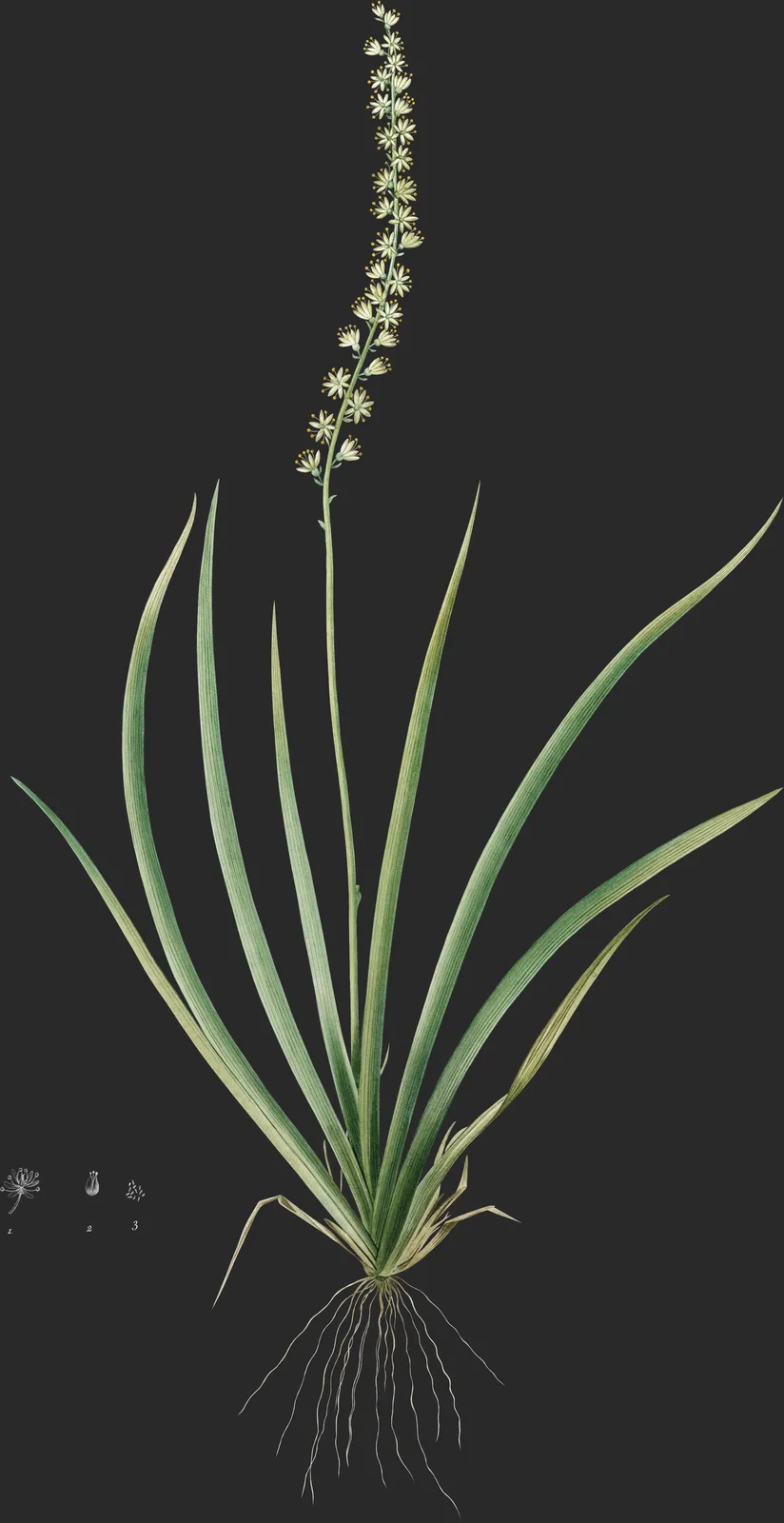
Tofieldia Palustris
粘菖蒲
Tofieldie des Marais
About this plate
Description
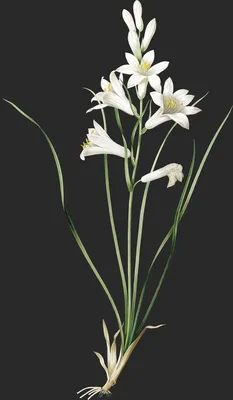
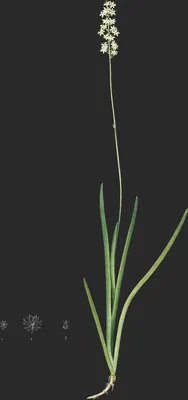
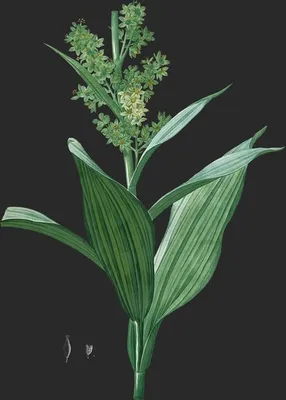
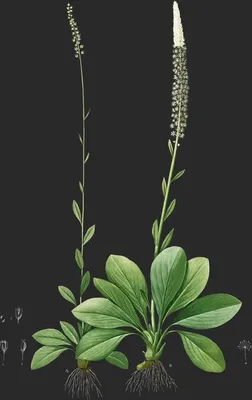
Une souche ligneuse horizontale ou oblique, de laquelle sortent des fibres radicales, nombreuses et presque simples, donne naissance à une ou plusieurs tiges cylindriques, droites ou un peu flexueuses, hautes de un à trois déci-mètres. Des feuilles radicales assez nombreuses, disposées sur deux rangs opposés, comprimées en forme de glaive, linéaires, longues de six à quinze centimètres, entourent la base de ces tiges, qui portent elles-mêmes deux ou trois feuilles pareilles, mais plus courtes.
Les fleurs, disposées en grappe terminale, étroite, plus ou moins longue et serrée, sont petites, blanches, portées sur des pédicelles très-courts. Chacun de ces pédicelles est accompagné à sa base d’une petite bractée membraneuse, et porte immédiatement au-dessous de la fleur une sorte de calice ou collerette extrêmement petite, formée d’une seule foliole à trois lobes peu distincts.
Le périgone est blanc, divisé profondément en six segments lancéolés, un peu aigus, concaves et étalés. Les filaments des étamines, au nombre de six, sont en forme d’alène, et presque aussi longs que les segments du périgone, à la base desquels ils sont insérés. Ils supportent des anthères ovales-arrondies.
L’ovaire est libre, ovale-oblong, divisé à son sommet en trois pointes, terminées chacune par un style tres-court et un stigmate simple. Il se transforme en une capsule à trois coques séparées au sommet, chacune desquelles est formée d’une seule valve, dont les bords, recourbés en dedans en manière de cloison, viennent se réunir dans l’axe du fruit. Les graines sont nombreuses, petites, brunes et oblongues.
Histoire
La Tolieldie des marais est assez commune dans le lieux tourbeus des Alpes, des Pyrénées, et de la plopart des montagnes de l’Europe et de la Sibérie, ois elle forme des gazons serrés. La difficulte de sa culture fait qu’on ne la voit que rarement dans les jardins. Elle fleurit en été.
Observations
Cette plante, réunie par Linné ans Anthérice, dont elle diffère par plusieurs caractères essentiels, en a été séparée avec raison par la plupart des auteurs modernes. Quelques-uns l’ont rapportée avec plas de fondement à d’autres genres plus connus, et particulièrement aux Helonias, dont elle se rapproche en effet par la structure de ses fleurs et de ses fruits, mais dont elle diflère par son port, par la présence d’une sorte de calice, et par le nombre plus considérable de ses graines: d’autres botanistes, an sentiment desquels nous croyons devoir nous ranger, en ont fait un genre à part auquel se rapportent quelques plantes de l’Amérique septentrionale, dont on doit la première connaissance au célèbre voyageur Michaux. Parmi les dillérents noms qu’on a assignés à ce genre, celui de Tofeldia, employé pour la première fois par Hudson, ayant l’avantage de n’avoir jamais été applique à aucune autre plante, doit être préféré.
Les Tolieldies doivent être séparées non-seulement des Anthéries, mais encore de la famille entière des Asphodèles. Elles appartiennent à la grande famille des Jones de M. de Jussieu, et particulièrement à ce groupe bien caractérisé dont M. Decandolle a fait une petite famille à part, sous le nom de Colchicacées. Elles séloignent cependant de ces dernières par le port, et se rapprochent davantage à cet égard des Alismacées.
Explication de la planche
La Plante entière de grandeur naturelle.
- Une fleur isolée.
- L’ovaire et les stigmates.
- Graines.
Fam. des Colchicacées. Juss.—Hexandrie trigynie. Lin.
- Tofieldia palustris. T. scapo foliolo obtecto, petalis lineari-obovatis. Pers. enchir. 1. p. 399.
- Toficidia palustris. Huds. Angl. 157. Smith. fl. Brit. 1. p. 397. Engl. bot. 1. 536. Fl. Fr. éd. 3. 1894.
- Anthericum calveulatum. A. folis ensiformibas, perianthis trilobis, filamentis glabris, pistillis trigynis. Fl. Suec. 269–888. It. Gotl. 194–221. Gmel. Sib. 1. p. 73. t. 18. f. 2. Lin. sp. pl. 447. Mill. dict. n. 10. Fl. Dan. t. 36. Ait. Kew. 1. p. 450.
- Anthericum pseudo-asphodelus. Jacq. Vind. 233.
- Anthericum filamentis lavibus, periantho trilido. Hort. Cliff. 140.
- Anthericum scapo nudo capitato, filamentis glabris. Fl. Lap. 137. t. 10. f. 3.
- Narthecium calyculatum. All. Ped. 2. 165. Lam. fl. Fr. 3. 298. dict. 4. p. 431. illustr. 1. 268.
- Narthecium iridifoliam. N. foliis ensiformibus compressis, racemo erecto, peduncalis brevissimis bracteolatis. Vill. Delph. 2. p. 225.
- Narthecium. Gerard. J. Galloprov. 142.
- Helonias borealis. H. foliis lineari-ensiformibus nervosis, bracteis duplicatis membranaceis. Willd. spec. pl. 2. p. 274.
- Helonias anthericoides. Hop. pl. rar. cent. 2.
- Scheuchzeria psendo-asphodelus. Scop. Carn. n. 445. Roth. Germ. 1. 159. 2. 419.
- Heritiera anthericoides. Schranck. Bav. n. 580.
- Anthericum filamentis glabris. Hall. Helv. n. 1205. Phalangiam Alpinum palustre, iridis folio. Seg. Ver. 2. p. 61. t. 14.
- Pseudo-asphodelus alpinus. Bauh. pin. 29.
Twelve ways of seeing
One plate, read twelve times over: its name, its colour, the burin and the brush, the shape of the sheet, the season, the soil it came from, the book it belongs to, its language of flowers, the poem it answers to, the lore behind it, how to look, and what remains.
-
The Name
The plate is titled “Tofieldia Palustris”, numbered Plate 256 (book page 256). No reliable binomial survives on the plate, so it must be cited by its original title. The Chinese name 粘菖蒲 is a modern rendering of the Latin, not an old garden name — between a plant and its names there is always translation.
-
Form and Colour
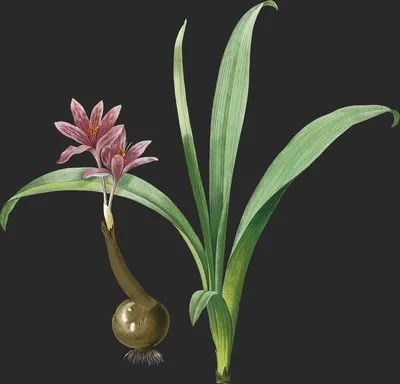
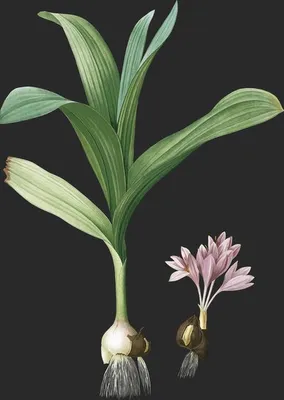
A bulb of overlapping fleshy scales gives the lily its Chinese name, 'hundred-fold'; six tepals reflex as the flower opens, around six stamens with long, T-shaped anthers. Filed under green — a moss green. That colour comes mostly from leaf, calyx and stem; the flower occupies a small patch. A botanical plate establishes the plant before it points at the bloom. Read the outline, then the colour layers, then the touch of the brush.
-
Line and Colour
The first half of the nineteenth century moved from copper to steel to lithography. Stipple could render the softest transition — Redouté's roses depend on it — while lithography suited broad, gentle washes. Look closely at the line and the colour: an unbroken line means engraving, colour crossing the outline by half a millimetre means hand-colouring. Craft leaves franker evidence than inscriptions.
-
Composition
Tall and narrow, the plant rising in one movement with generous margins above and below — the upright format of most floras. (about 1.94 : 1). No details are appended: this is a plate for looking, not for keying out.
-
Season
Early to high summer, June and July; the flowers last only days, so artists drew them just as they opened. The year 1809 on the plate is the year of publication, not of flowering — the gathering came a year or two earlier.
-
Provenance
Temperate north — China, Japan, Europe. Long used in Chinese medicine, lilies were hunted in East Asia by nineteenth-century collectors and transformed European gardens. In the same volume the kin are shelved together; set several plates side by side and the differences declare themselves.
-
The Book
“The Liliaceae” was drawn by Pierre-Joseph Redouté and published 1802-1816. This plate is Plate 256, book page 256. The image is in the public domain; the hand-colouring on the paper is still one person's hand, two centuries ago.
-
Symbolism
In the West the white lily is Marian purity, held by the angel of the Annunciation; in China the name sounds like 'a hundred years in harmony', a wedding wish. In a flora it is a species first and a symbol second; the order is worth keeping.
-
Poetic Resonance
木末芙蓉花,山中发红萼。涧户寂无人,纷纷开且落。
—— 唐·王维《辛夷坞》
Lotus blossoms at the branch tips put forth red calyces in the hills. By the silent ravine, they open and fall, open and fall.
The poem gives the mood first and the picture supplies the form; set the line beside the plate and the green the corolla becomes its resting point.
-
Classical Lore
The Bencao Gangmu describes the bulb as garlic-like, edible and medicinal; Song writers already noted that the leaves vary while the flowers stay white. Chinese flower books ranked plants by character; European floras described them by form and name. This plate belongs to the second tradition, yet bears reading by the first. Books fill in what the picture omits, and also hide what it shows: look first, read after.
-
How to Look
Watch how far the tepals reflex, and the anther colour: green before opening, brown as the flower fades. A sectioned bulb is the mark of a botanical plate. Stand back for the habit, step close for the meeting of line and colour.
-
Afterword
Two centuries on, the plant may still flower in some garden; the one on this sheet stopped in the season of 1809.