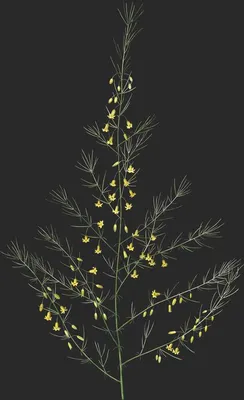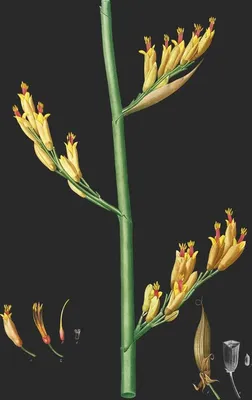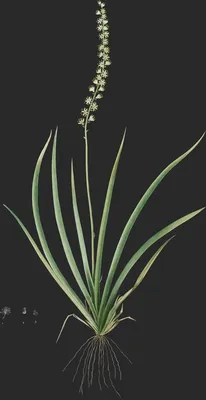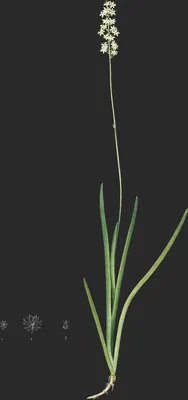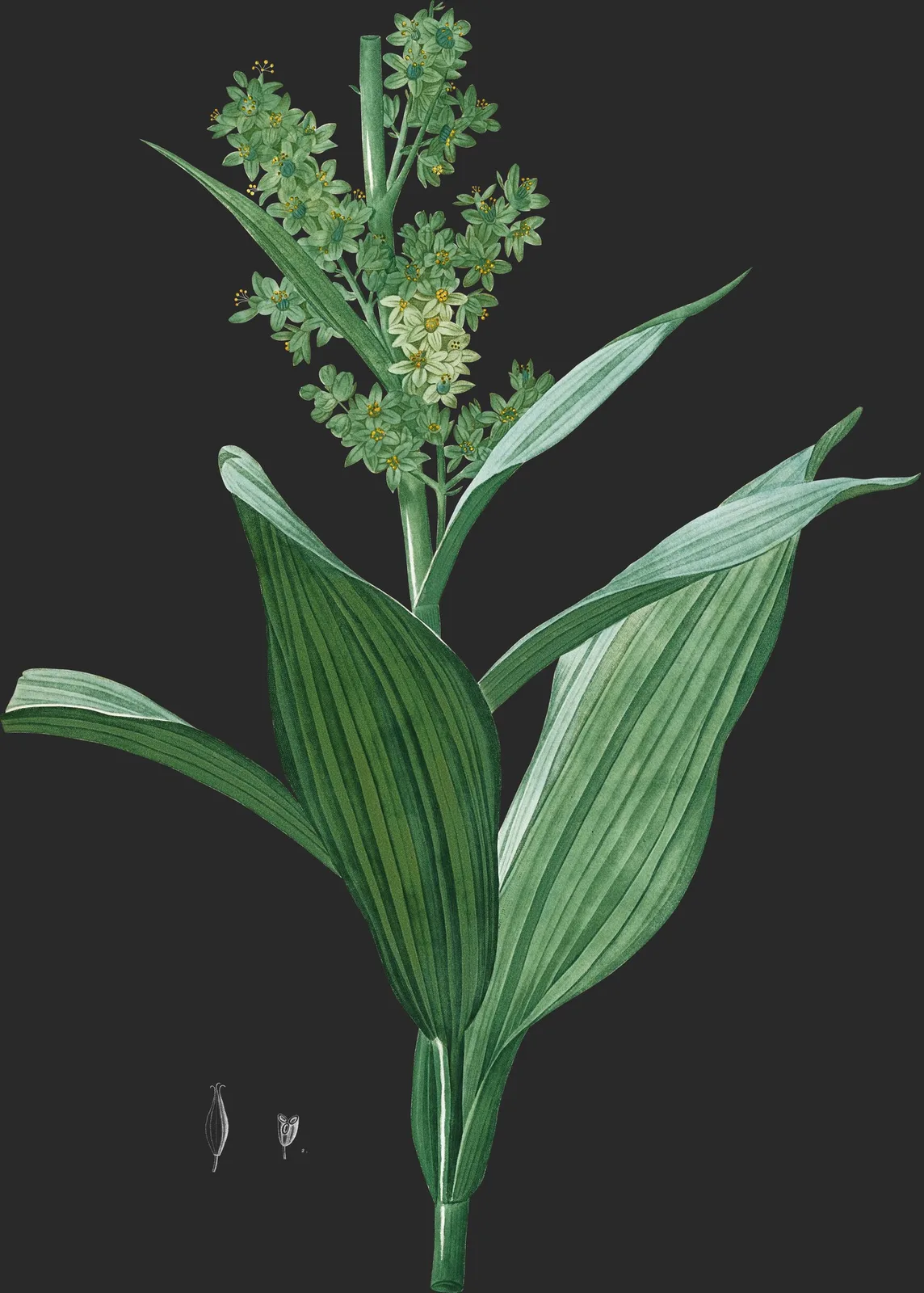
Veratrum Album
Vératre Blanc
Vératre Blanc
About this plate
Description
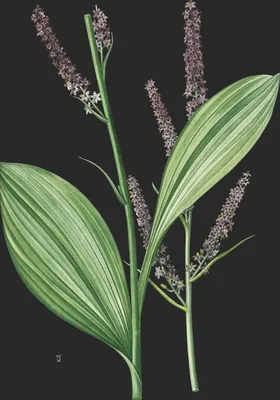
La racine est une bulbe pyriforme couverte de tuniques noirâtres, sous lesquelles il y en a d’autres un peu jaunâtres. Cette bulbe produit de sa base une botte de radicales qui sont plas grosses que des tuyaux de plumes de corbeau, cylindriques, très-légèrement jaunâtres en dehors, blanches en dedans, longues de trois décimètres (environ un pied), chevelues senlement vers leur extrémité. Ces radicales sont obliques; il n’y en a point de perpendiculaires, et celles de centre de la base de la bulbe sont les plus courtes. Une fibre ligneuse résistante parcourt longitudinalement le milieu de chaque radienle, et est reconverte d’un parenchyme épais tenant à lécorce. Cette fibre, si Ton cherche à rompre en deux portions, par le milieu, une des radicales, sort entière de l’une des deux portions dans laquelle parait alors un tabe ou canal qu’elle remplissait.
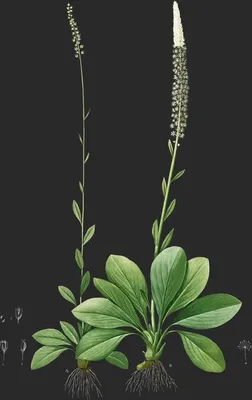
La tige est simple, droite, cylindrique, haute d’un mètre à treize décimètres (trois à quatre pieds), grosse comme le doigt, fistaleuse, garnie de fenilles alternes, ovales-aigues, plissées entre leurs nervares nombreuses longitudinales et paralleles. Les feuilles inférieures sont ovales, un peu arrondies; celles du milien de la tige sont engainantes, sans fissure à leur base. Une longue grappe de fleurs occupe environ la moitié supérieure de la plante. Les feuilles ou bractées, situées sous les rameaux de la grappe, diminuent d’autant plus de grandeur, qu’elles naissent sous des rameaux plus élevés; quelques rameaus inférieurs sont composés; les supérieurs sont simples. Les uns et les autres s’écartent de la tige par un angle médioerement ouvert. Les fleurs sont alter-nes, pedicellées dans l’aisselle d’une bractée courte. Le périgone est ouvert en roue, à six divisions égales, ovales-oblongues, rétrécies en onglet par la base, canaliculées sur cet onglet, qui est vert foncé, épaissi sur les bords. La lame des divisions est ragée de nervores trés-vertes, sur un fond jaune pale, aigat au sommet, bordée d’une membrane déchiquetée. Six étamines ont leurs filets insérés et opposés à la base des divisions de périgone, presque égaux en longueur à ces divisions; ils sont eylindriques ou un peu prismatiques, rapprochés en colonne dans leur moitié inférieure, divergents et arqués en dehors dans leur moitié supérieu Les antheres sont en deux lobes réniformes-allongés, inéga ouvertes en dehors. L’ovai avorte dans le plus grand nombre des fleurs. Il est supère, pyramidal, dans les fleu hermaphrodites, à trois angles et à trois côtés, et porte trois styles arqués en dehors, dont les stigmates sont fort petits et terminaux. Le fruit est formé de trois capsules lancéolées sondées par la base, distinetes à leur sommet, qui s’ouvrent par une suture intérieure. Les graines sont droites, oblongues, comprimées, bordées par une membrane, attachées alternativement à chacum des bords qui résultent de la déhiscence intérieure des valves.
Histoire
Le Vératre blane croit dans les prés humides et montagneux de l’Europe, dans les Alpes, en Allemagne, en Italie et dans la Grece. Les Grecs lui donnaient le nom d’Hellebore banc, et l’employaient comme vomitif. Les Latins l’ont appelé Veratrum. Cette plante réussit dans les jardins; elle fleurit au mois de juillet.
Explication de la planche
La Plante en fleurs de grandeur naturelle, tronguée par la base et par son sommet.
- Le fruit composé de trois capsules réunies
- Le même coupé en travers.
Fam. des Colchicacées. Fl. Franç.—Polygamie monœcie. Lin.
- Veratram album. V. racemis paniculatis, bracteis ramorum oblongis, partialibas pedunenlum pubescentem subequantibus; floribus erectis. Willd. spec. pl. 4. p. 895.
- Veratrum racemo supradecomposito, corollis erectis. Lin. spec. plant. p. 1479. Lamarck. illustr. t. 843. Bull. Herb. t. 155. Gærn. Fruct. 1. p. 71. t. 18. Jacq. Flor. austr. 4. t. 355. Persoon. enchir. 1. p. 397. Flor. dan. t. 1120. Flor. franç. édit. 3. n. 1895.
- Veratrum pedunealis corolla patentissimâ longioribus. Gmel. Sib. 1. p. 76.
- Helleboram sen veratram album. Dod. pempt. 383. ic.
- Helleborns albus, flore subviridi. C. B. pin. 186.
- Helleboras albus, exalbido flore. Clus. hist. 1. p. 274. ic.
Twelve ways of seeing
- measured cast yellow-green
- upright 1.40 : 1
- published 1814
- Plate 447
Not a catalogue entry but a way of looking: how to stand, what to notice, how the line was cut, when it flowers, where it came from, who made it — and then the poems and the classics that taught China to see the same flower. Read the twelve in order and the plate opens.
-
First Look
六法者何?一、气韵生动是也;二、骨法用笔是也;三、应物象形是也;四、随类赋彩是也;五、经营位置是也;六、传移模写是也。
—— 南齐·谢赫《古画品录》
The six laws: spirit resonance alive; bone-method in the brush; matching form; colour by kind; planning the placing; copying the masters.
The sheet is vertical: the eye climbs and settles in the upper half. Let the plant stand before you look for detail. Then step in close: watch where colour meets line, and whether the line ever breaks. Third, find where the green is deepest: the whole tonal order is measured from that patch.
-
Name and Thing
The binomial is Veratrum album: the first word is the genus it belongs among, the second the epithet that sets it apart. Two words carry a whole provenance. The older system filed it under Colchicaceæ by overall affinity; Linnaeus, counting stamens only, placed it in Polygamia — two ways of asking what a plant is. No established Chinese name exists, so it is cited by its binomial alone.
-
Form and Colour
Measured on this plate: flower colour is sparing, 0.2% of the sheet against 16.6% of foliage, the cast tending yellow-green — as with pale or white blooms, outline and tone do the talking. A bulb of overlapping fleshy scales gives the lily its Chinese name, 'hundred-fold'; six tepals reflex as the flower opens, around six stamens with long, T-shaped anthers. Filed under green — a moss green, a colour that comes mostly from leaf and stem. Read the outline, then the colour layers, then the brush.
-
Composition
Tall and narrow, the plant rising in one movement with generous margins — the upright format of most floras. (about 1.40 : 1) No details are appended: a plate for looking, not for keying out. The plant covers only 20% of the sheet, centred near the centre; the emptiness is where the eye rests. Old plates set the plant slightly off centre, with unequal margins — that small imbalance is what keeps it alive.
-
Line and Colour
The first half of the nineteenth century moved from copper to steel to lithography; stipple could render the softest transition. There is evidence on the back too: the plate mark pressed into the paper, the slight relief of the pigment, lines worn shallow in a later printing.
-
Season
Early to high summer, June and July; the flowers last only days, so artists drew them just as they opened. The year 1814 on the plate is that of publication, not of flowering — the gathering came a year or two earlier. The plate records ten days of peak; the other three hundred are leaf, fruit and rest.
-
Provenance
Temperate north — China, Japan, Europe. Long used in Chinese medicine, lilies were hunted in East Asia by nineteenth-century collectors and transformed European gardens. In the same volume the kin are shelved together; set several plates side by side.
-
The Book and the Hand
“The Liliaceae” was drawn by Pierre-Joseph Redouté and published 1802-1816. This plate is Plate 447, book page 447. The image is public domain; the hand-colouring is still one person's hand.
-
Poetic Resonance
更乞两丛香百合,老翁七十尚童心。
—— 宋·陆游《窗前作小土山蓻兰及玉簪最后得香百合并种之戏作》
The poem gives the mood first and the picture supplies the form; set the line beside the plate and the green the corolla becomes its resting point.
-
The Written Tradition
生川谷。《吴普》曰:百合一名重迈,一名中庭,生冠朐及荆山。(艺文类聚引云:一名重匡)《名医》曰:一名重箱,一名摩罗,一名中逢花,一名强瞿,生荆州,二月八月,采根,暴干。
—— 神农本草经·百合第一百七十
The Bencao Gangmu describes the bulb as garlic-like, edible and medicinal; Song writers already noted that the leaves vary while the flowers stay white. Keep the line; it will surface the next time you meet the same plant.
-
Symbolism
In the West the white lily is Marian purity, held by the angel of the Annunciation; in China the name sounds like 'a hundred years in harmony', a wedding wish. Flower language was added later; the flower knows nothing of it, and that innocence is part of its power.
-
What to Take Away
If you keep one line, keep Guo Xi's: from afar its momentum, up close its texture. A flora exists to be consulted; look long enough and you forget to consult — someone in 1814 gave a whole day to a single flower.