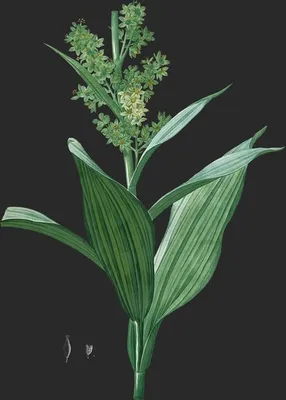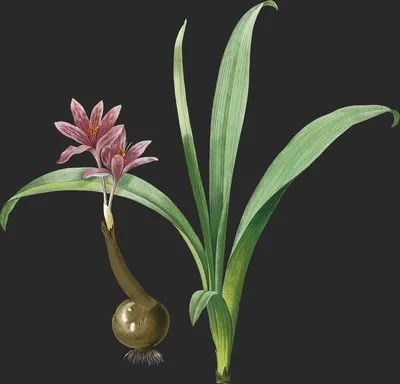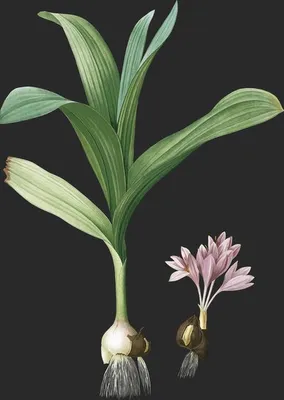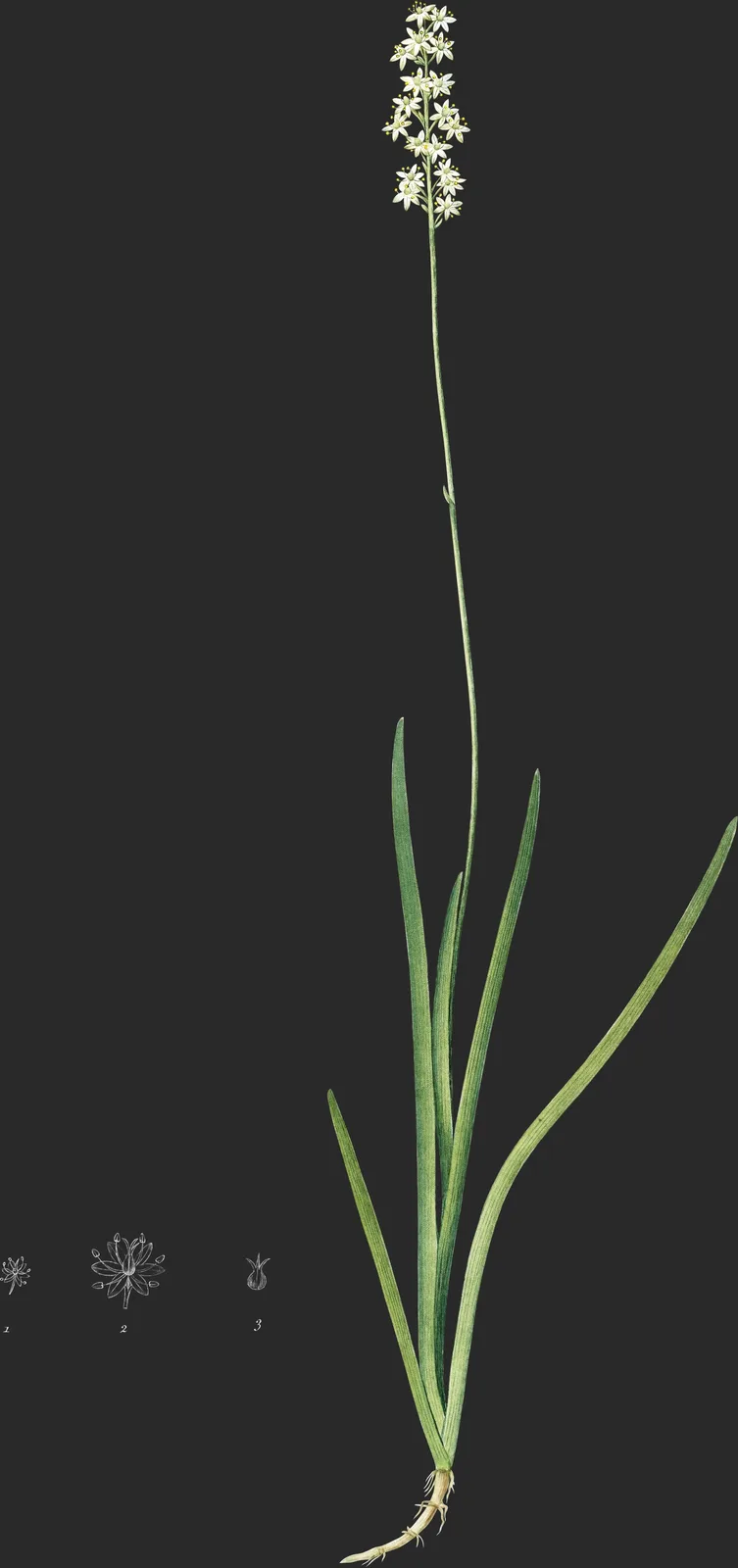
Tofieldia Pubescens
Tofieldie Pubescente
About this plate
Description
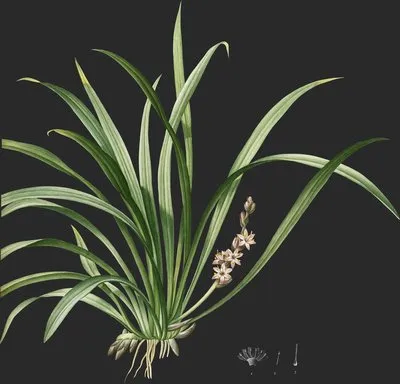
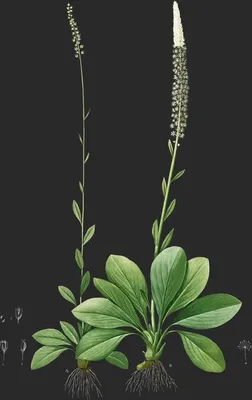
Une racine grele, traçante, ligneuse et présentant de distance en distance des nodosités circulaires qui émettent des fibres descendantes peu nombreuses, donne naissance à une tige grèle, droite, haute de trois ou quatre décimètres, nue dans la plus grande partie de sa longueur, hérissée de poils roides, nombreux et trés-courts, qui la rendent rude au toucher.
Les feuilles ont beaucoup de rapports avec celles des plantes de la famille des Iridées. Elles sont disposées sur deux rangs opposés, comprimées en forme de glaive, engainantes, linéaires, longues de dix à quinze centimètres, larges de quatre à cinq millimètres, glabres, terminées par une pointe acérée; la plupart sont radicales, mais la tige en porte dans le bas une ou deux semblables aux autres.
Les fleurs sont petites et forment une grappe cylindrique, étroite, longue de quatre à six centimètres. Elles sont groupées trois à trois et soutenues par des pédicelles pubescents, longs de trois millimètres. A la base de chaque groupe sont trois bractées arrondies, pubescentes, extrèmement petites. Chacun des pédicelles porte, un peu au dessous de la fleur, une petite collerette ou sorte de calyce formée d’une seule pièce, concave, enfilés par le milieu, triangulaire avec les angles mousses.
Le périgone est blanchâtre, divisé jusqu’à sa base en six segments étalés, oblongs, concaves, un peu aigus.
Les filaments des étamines sont en forme d’alène, de la même longueur que les segments du périgone. Les anthères sont brunes, en forme de cœur, insérées par le bas, et redressées.
L’ovaire est arrondi, creusé de trois sillons profonds et rétréci au sommet en un prolongement triangulaire, qui se divise bientôt en trois styles égaux en longueur aux étamines. Les stigmates sont simples et arrondis.
Histoire
La Tofieldie pobescente est indigène des parties basses de la Caroline. Nous la dérivons d’après des échantillons en très-bon état, recueillis par M. Bose, et conservés dans l’herbier de M. Decandolle.
Explication de la planche
La Plante entière de grandeur naturelle.
- Une fleur détachée de grandeur naturelle.
- Une fleur grossie.
- Lovaire et le style.
Fam. des Colchicacées. Fl. Franç.—Hexandrie trigynie. Lin.
- Tofieldia pubescens. T. spica oblonga interrupta, petalis lanceolatis acutis. Pers. enchir. 1. 399.
- Nartheciam pubens. N. scapo, rachi pedicellisque quasi pulveralento-pubentibus et asperiasculis: spicâ oblongâ, fasciculis plucimis interraptâ: capsulâ subglobosâ, vix ealycem superante. Mich. fl. Bor. Amer. 1. p. 209.
- Melanthiam racemosum. Walt. fl. Carol.
- Antherieum folis ensiformibus, perianthiis trilobis, filamentis glabris. Gron. fl. Virg. éd. 2. p. 51.
Twelve ways of seeing
- measured cast yellow-green
- upright 2.13 : 1
- published 1811
- Plate 324
Not a catalogue entry but a way of looking: how to stand, what to notice, how the line was cut, when it flowers, where it came from, who made it — and then the poems and the classics that taught China to see the same flower. Read the twelve in order and the plate opens.
-
First Look
江馆清秋,晨起看竹,烟光日影露气,皆浮动于疏枝密叶之间。
—— 清·郑板桥《题画竹》
On an autumn morning at the river lodge I looked at the bamboo: mist, sunlight, dew, all drifting among the sparse and dense leaves.
The sheet is vertical: the eye climbs and settles in the upper half. Let the plant stand before you look for detail. Then step in close: watch where colour meets line, and whether the line ever breaks. Third, find where the green is deepest: the whole tonal order is measured from that patch.
-
Name and Thing
The binomial is Tofieldie pubescente: the first word is the genus it belongs among, the second the epithet that sets it apart. Two words carry a whole provenance. The older system filed it under Colchicaceæ by overall affinity; Linnaeus, counting stamens only, placed it in Hexandria — two ways of asking what a plant is. No established Chinese name exists, so it is cited by its binomial alone.
-
Form and Colour
Measured on this plate: flower colour is sparing, 0.1% of the sheet against 3.7% of foliage, the cast tending yellow-green — as with pale or white blooms, outline and tone do the talking. A bulb of overlapping fleshy scales gives the lily its Chinese name, 'hundred-fold'; six tepals reflex as the flower opens, around six stamens with long, T-shaped anthers. Filed under green — a moss green, a colour that comes mostly from leaf and stem. Read the outline, then the colour layers, then the brush.
-
Composition
Tall and narrow, the plant rising in one movement with generous margins — the upright format of most floras. (about 2.13 : 1) No details are appended: a plate for looking, not for keying out. The plant covers only 5% of the sheet, centred below centre; the emptiness is where the eye rests. Cover the margins with your thumb and the plate suffocates; uncover them and the flower breathes again.
-
Line and Colour
The first half of the nineteenth century moved from copper to steel to lithography; stipple could render the softest transition. There is evidence on the back too: the plate mark pressed into the paper, the slight relief of the pigment, lines worn shallow in a later printing.
-
Season
Early to high summer, June and July; the flowers last only days, so artists drew them just as they opened. The year 1811 on the plate is that of publication, not of flowering — the gathering came a year or two earlier. The plate records ten days of peak; the other three hundred are leaf, fruit and rest.
-
Provenance
Temperate north — China, Japan, Europe. Long used in Chinese medicine, lilies were hunted in East Asia by nineteenth-century collectors and transformed European gardens. In the same volume the kin are shelved together; set several plates side by side.
-
The Book and the Hand
“The Liliaceae” was drawn by Pierre-Joseph Redouté and published 1802-1816. This plate is Plate 324, book page 324. The image is public domain; the hand-colouring is still one person's hand.
-
Poetic Resonance
两丛香百合,一架粉长春。
—— 宋·陆游《北窗偶题四首 其一》
The poem gives the mood first and the picture supplies the form; set the line beside the plate and the green the corolla becomes its resting point.
-
The Written Tradition
生川谷。《吴普》曰:百合一名重迈,一名中庭,生冠朐及荆山。(艺文类聚引云:一名重匡)《名医》曰:一名重箱,一名摩罗,一名中逢花,一名强瞿,生荆州,二月八月,采根,暴干。
—— 神农本草经·百合第一百七十
The Bencao Gangmu describes the bulb as garlic-like, edible and medicinal; Song writers already noted that the leaves vary while the flowers stay white. Keep the line; it will surface the next time you meet the same plant.
-
Symbolism
In the West the white lily is Marian purity, held by the angel of the Annunciation; in China the name sounds like 'a hundred years in harmony', a wedding wish. In a flora it is a species first and a symbol second; the order is worth keeping.
-
What to Take Away
Carry three rules away: whole before detail; line before colour; picture before book. The flower of that year is dust, yet its image on paper has outlived every living cousin.