Medeola Asparagoïdes
Medeola Sarmenteux
About this plate
Description
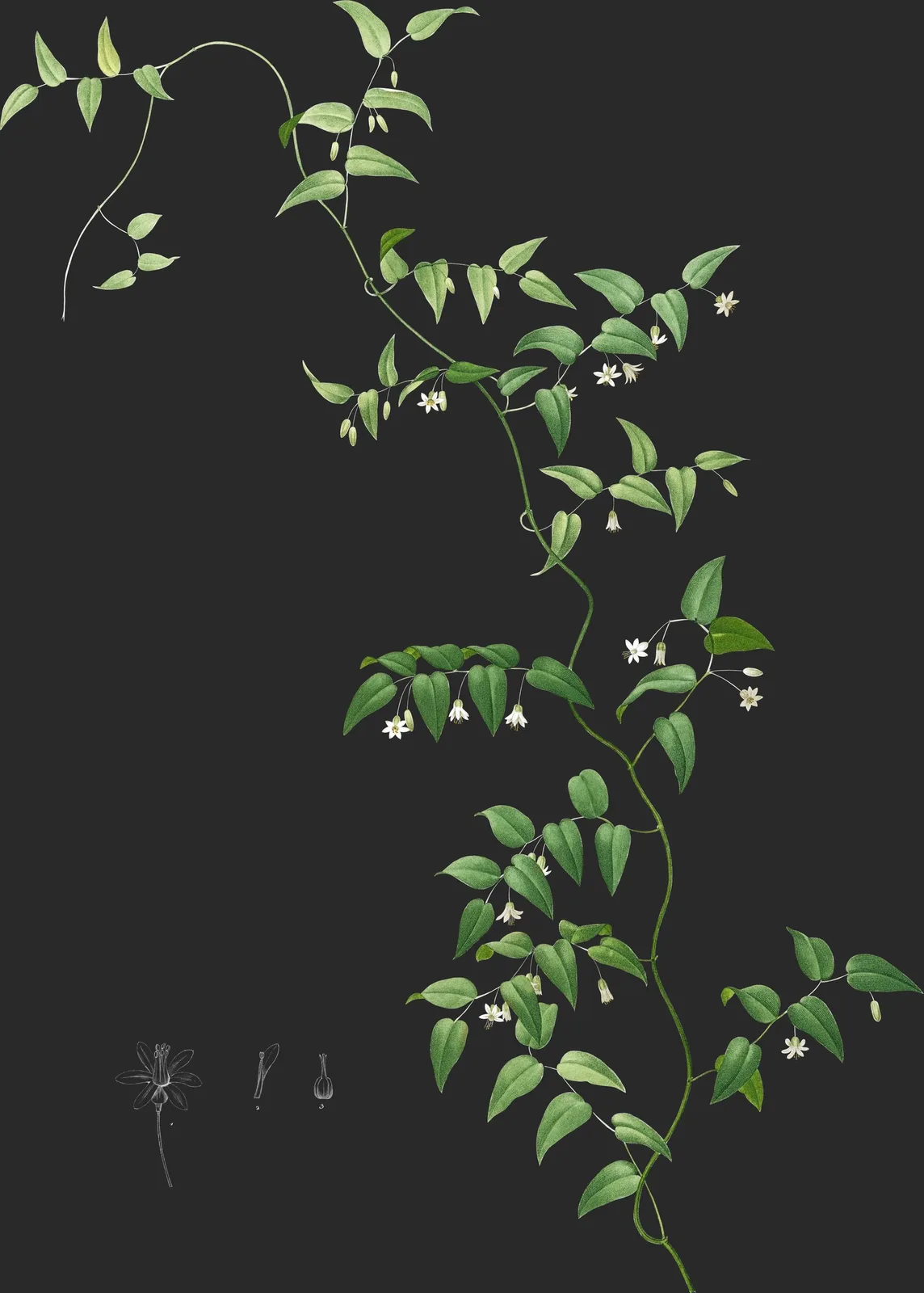
Tige sarmentense, grimpante, flexueuse, haute d’un mètre à un mètre et demi (de trois pieds à quatre pieds et demi), garnie de rameaux courts, alternes et comme distiques, assez réguliers, un peu en zig-xag, et qui portent six à dix feuilles. Une petite stipmle membraneuse est placée sous l’aisselle de chaque rameau. Les feuilles sont alternes, et chacune d’elles est accompagnée en dessous d’une petite stipule; elles sont sessiles, solitaires, ovales, tres-aigues à leur sommet, arrondies et un peu en cour à leur base, un peu obliques, ayant leur nervares parallèles et longitudinales, sans côte moyenne. Ces feuilles sont un peu luisantes et d’un vert très-gai.
Les fleurs sont pendantes sous l’aisselle des feuilles, placées entre la base de ces feuilles et les stipales qui les accompagnent. Leurs pédoncules naissent deus à deux ou solitaires, et sont plus courts que les feuilles.
Le périgone est à six divisions oblongues, un peu réfléchies, ouvertes et évasées en cloche, vertes à leur base et sur leur nervure moyenne, blanchâtres en dedans et sur leurs bords. La base du périgone est rétrécie et étranglée au-dessus d’an petit bourrelet circulaire, au moyen duquel le périgone s’articule avee le pédoncule. Il y a six étamines droites, un peu plus courtes que les di visions du périgone. Trois styles droits et rapprochés surmontent l’ovaire, qui est ovoïde et à trois canelures.
Histoire
Le Medeola sarmenteux est indigène du Cap de Bonne-Espérance. On le coltive dans les jardins botaniques, où il manque rarement de fleurir: on l’abrite l’hiver dans les serres tempérées.
Observations
Les Medeola diffèrent des Asperges par les trois styles distinets et par les fruits, renfermant senlement trois graines, L’allinité entre ees deux genres se retrouve dans larticulation la base du périgone avee le pédoneale. On ne trouve point cette arli dans le Medeola Virginica, dont le port annonce un genre distinct, et qui est caractérisé par trois styles horizontaux divariqués qui sallongent plas que la fleur, et qui sont caduques. Nous avons reconnu Particulation des leurs sur les pédoncules dans plasieurs espèces que nous avons pu voir du genre Rescus, qui ressemble plus que tont autre au Medeola et à l’Asparagus.
Nous ne mettons nullem en donte que les feuilles du Medeola Aspargoïdes sont simples non pinnées. Nous avons com maré ces feuilles à celles de plusieurs espèces de Smilax et de Rusus, qui ont évidemment des fenilles simples quoiqu’ells soient disposées avec une certaine regalarité sur de courts rameaux qui, par leur proportion seulement, imitent des pétioles de feuilles composées. Ces rameaus se changent fréquemment en rameaux plus grands, et perdent alors toute la ressemblance qu’ils avaient avec des pétioles. Il ne conviendrait done point de les appeler des pétioles, ni de regarder comme des Folioles les vraies feuilles simples qui les garnissent.
Explication de la planche
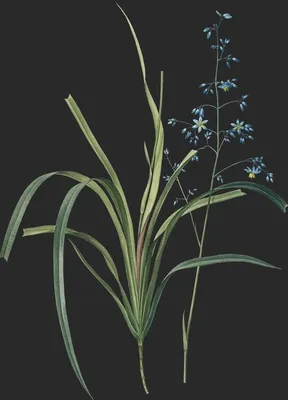
La Plante de grandeur naturelle.
- Une fleur plas grande que nature.
- Une des divisions de la fleur avec une étamine.
- Le pistil.
Fam. des Asperges. Juss.—Hexandrie trigynie. Lin.
- Medeola asparagoïdes. M. folis alternis, ovatis, basi sub-cordatis, obliquis. Ait. Kew. 1. p. 489. Desrousseaux in Lamarck. Dict. encyclop. 4 p. 4. Willd. spec. pl. 2. p. 270. Persoon. enchirid. 1. p. 598.
- Asparagos africanus scandens, myrtifolio. Till. pis. 16. tab. 12. fig. 1.
- Medeola asparagoïdes. M. folis pinnatis; foliolis alternis. Lin. spec. plant. 484. Excluso Hermanni synonymo.
Twelve ways of seeing
- green key
- upright 1.40 : 1
- published 1814
- Plate 442
Not a catalogue entry but a way of looking: how to stand, what to notice, how the line was cut, when it flowers, where it came from, who made it — and then the poems and the classics that taught China to see the same flower. Read the twelve in order and the plate opens.
-
First Look
搜尽奇峰打草稿。
—— 清·石涛《苦瓜和尚画语录》
Exhaust the strange peaks, and then make the sketch.
The sheet is vertical: the eye climbs and settles in the upper half. Let the plant stand before you look for detail. Then step in close: watch where colour meets line, and whether the line ever breaks. Third, find where the green is deepest: the whole tonal order is measured from that patch. The pose leans left: the upper half carries 12 points further left than the lower — a living thing, not a diagram.
-
Name and Thing
The binomial is Medeola sarmenteux: the first word is the genus it belongs among, the second the epithet that sets it apart. Two words carry a whole provenance. The older system filed it under Asparagaceæ by overall affinity; Linnaeus, counting stamens only, placed it in Hexandria — two ways of asking what a plant is. No established Chinese name exists, so it is cited by its binomial alone.
-
Form and Colour
A bulb of overlapping fleshy scales gives the lily its Chinese name, 'hundred-fold'; six tepals reflex as the flower opens, around six stamens with long, T-shaped anthers. Filed under green — a moss green, a colour that comes mostly from leaf and stem. Read the outline, then the colour layers, then the brush.
-
Composition
Tall and narrow, the plant rising in one movement with generous margins — the upright format of most floras. (about 1.40 : 1) No details are appended: a plate for looking, not for keying out. The plant covers only 9% of the sheet, centred a little right of centre; the emptiness is where the eye rests. Old plates set the plant slightly off centre, with unequal margins — that small imbalance is what keeps it alive.
-
Line and Colour
The first half of the nineteenth century moved from copper to steel to lithography; stipple could render the softest transition. There is evidence on the back too: the plate mark pressed into the paper, the slight relief of the pigment, lines worn shallow in a later printing.
-
Season
Early to high summer, June and July; the flowers last only days, so artists drew them just as they opened. The year 1814 on the plate is that of publication, not of flowering — the gathering came a year or two earlier. Note the season. Phenology is the most practical tool of appreciation.
-
Provenance
Temperate north — China, Japan, Europe. Long used in Chinese medicine, lilies were hunted in East Asia by nineteenth-century collectors and transformed European gardens. The volume was made in 1802-1816, when most of this knowledge came from living plants under glass.
-
The Book and the Hand
“The Liliaceae” was drawn by Pierre-Joseph Redouté and published 1802-1816. This plate is Plate 442, book page 442. The image is public domain; the hand-colouring is still one person's hand.
-
Poetic Resonance
更乞两丛香百合,老翁七十尚童心。
—— 宋·陆游《窗前作小土山蓻兰及玉簪最后得香百合并种之戏作》
The poem gives the mood first and the picture supplies the form; set the line beside the plate and the green the corolla becomes its resting point.
-
The Written Tradition
百合之根,以众瓣合成也。
—— 明·李时珍《本草纲目·菜部》
The root of the lily is many scales gathered into one — hence the name bai he, “a hundred joined”.
The Bencao Gangmu describes the bulb as garlic-like, edible and medicinal; Song writers already noted that the leaves vary while the flowers stay white. The difference is not of quality but of question: Europe asks what it is, China asks whom it resembles.
-
Symbolism
In the West the white lily is Marian purity, held by the angel of the Annunciation; in China the name sounds like 'a hundred years in harmony', a wedding wish. Flower language was added later; the flower knows nothing of it, and that innocence is part of its power.
-
What to Take Away
Carry three rules away: whole before detail; line before colour; picture before book. The flower of that year is dust, yet its image on paper has outlived every living cousin.