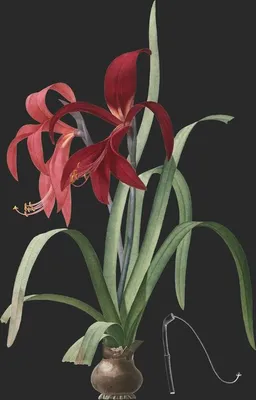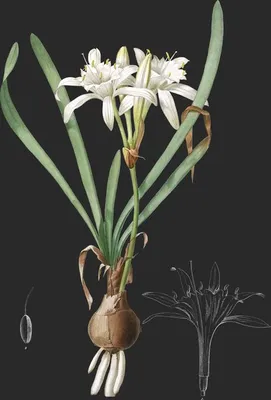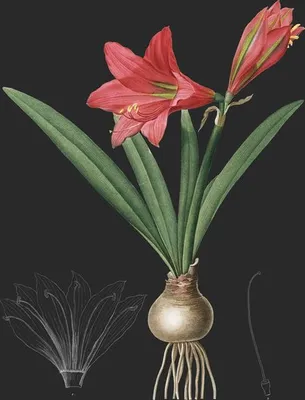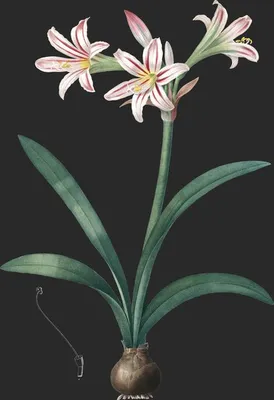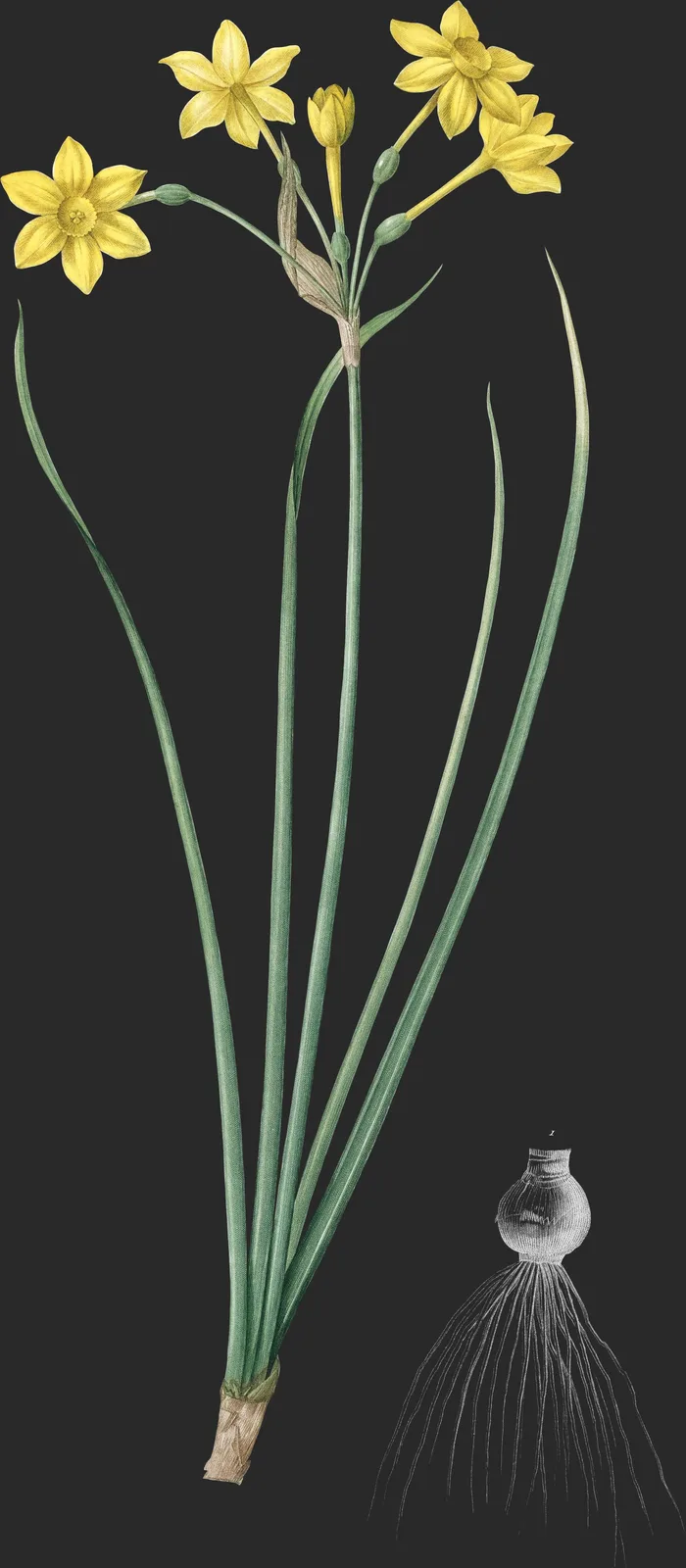
Narcissus Jonquilla
水仙属·Narcissus Jonquilla
Narcisse Jonquille
About this plate
Description
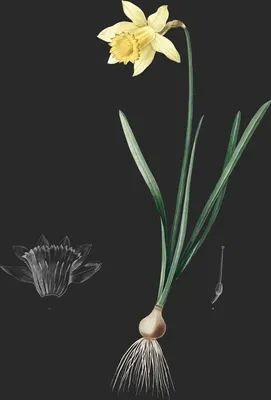
La Jonquille diffère de toutes les autres espèces de Narcisses par ses feuilles demi-cylindriques, a-peu-près en forme d’alène, asses semblables à celles des Jones, d’oi on a tiré son nom. Elle se reconnait encore à la couleur particulière de ses fleurs et à son godet court et en forme de cloche: sa bulbe est alongée, recouverte d’une tunique brune; ses feuilles sont droites, lisses; sa hampe est droite, tendre, sillonnée, un peu anguleuse, terminée par une spathe scarieuse et d’une senle pièce; les fleurs sont portées sur des pédoneules inégaux, le plus souvent dirigées du même côté: dans les individus cultivés, leur nombre varie de deux à sept; dans les individus sauvages, il ne s’y trouve ordinairement que deux à trois fleurs, et quelquefois une seule: ces fleurs sont plus petites que dans les autres Narcisses, mais remarquables par la suavité de leur parfum; leur tube est grêle, cylindrique; leur limbe est à six lanières ovales, presque arrondies, terminées par une petite pointe; leur godet est très-court, légèrement crénele; il offre à son entrée les anthères des trois étamines supérieures, tandis que les trois inférieures sont cachées dans le tube.
Histoire
La Jonquille est indigène des prairies humides de l’Europe méridionale. Clasins dit qu’elle croit spontanément en Espagne, pris de Tolède,1 et entre Cadix et Séville. Linne l’indique aussi comme originaire de l’Orient. En France, elle se trouve aux environs d’Aix en Provence, selon M. Gérard; dans le bas Languedoc, près Montpellier, selon M. Gouan, et a été trouvée sur les Pyrénées, dans les prairies de Gèdres, par M. Ramond: on assure aussi qu’elle est sauvage aux environs d’Abbeville; mais il est probable qu’on y trouve seulement des individas échappés des jardins.
La Jonquille est du petit nombre des plantes indigènes que nous cultivons dans les jardins d’ornement, et elle s’y conserve sans altération an milieu des nombreuses variations que subissent toutes les autres plantes cultivées. Il parait que les soins de l’homme n’ont pu parvenir qu’à augmenter un peu le nombre ordinaire de ses fleurs, et à les faire doubler; encore même on cultive autant de Jonquilles simples que de Jonquilles doubles. Leur mérite consiste dans leur odeur, qui est très-suave lorsquon la respire en plein air ou en petite quantité, mais qui est dangereuse pour les personnes nerveuses, lorsqu’elle a trop d’intensité. On doit éviter de placer des Jonquilles dans les appartements fermés, et surtout dans les chambres à coucher.
Cette plante craint peu le froid, et supporte même les gelées de nos climats. On la plante dans une bonne terre franche sans fumier; mais on remarque qu’au bout de quelques années, elle dépérit lorsqu’on la laisse dans le même terrain; ce qui fait qu’on doit enlever chaque année les oignons, pour les replacer dans de la terre nouvelle.
Fam. des Narcisses. Juss.—Hexandrie monogynie. Lin.
- Narciasus Jonquilla. N. spathâ multillorâ, coronâ campanulatâ brevi, foliis subulatis. Syn. Fl. gall. p. 165. Fl. fr. n. 1983.
- Narcissus-Jonquilla. N. spathâ multiflorâ, nectario hemisphærico crenato, foliis semiteretibus, Lin. Spec. 417. hort. Ups. 75. Mill. Dict. n. 9.
- Narcissus Jonquilla. N. spathâ multiflorâ, nectario campanulato brevi, foliis subulatis. Lin. syst. veg. 263. Lam. Dict. 4. p. 427. Curt. bot. mag. t. 15. Willd. Spec. 2. p. 41. Pers. ench. 350.
- Narcissus Jonquilla. Bull. herb. t. 334.
- Narcissas Jonquilla. N. foliis semiteretibus. Haw. trans. Lin. soc. 5. p. 245.
- Narcissas foliis subulatis, florum nectario brevissimo. Lin. hort. Clff. 134. Roy. Lugd-b. 35. Sauv. monsp. 19.
- Narcissas Juncifolius luteus minor. C. Bauh. pin. 51.
- Narcissus Juncifolius oblongo calice luteus major. C. Bauh. pin. 51.
- Narcissus Juncifolius minor et secundus. Clus. hist. 1. p. 159.
- B. Narcissus pallidos. N. spathâ uniflorâ, tubo calicem subaquante fimbriato. Lam. Dict. 4. p. 424.
- Ell ne croit pas dans l’ile de la Guadeloupe, et c’est part une fausse interprétation de Clusius que ce fait se trouve consigné dans quelques ouvrages.
Twelve ways of seeing
- measured cast yellow-green
- upright 2.28 : 1
- published 1805
- Plate 159
Not a catalogue entry but a way of looking: how to stand, what to notice, how the line was cut, when it flowers, where it came from, who made it — and then the poems and the classics that taught China to see the same flower. Read the twelve in order and the plate opens.
-
First Look
竖划三寸,当千仞之高;横墨数尺,体百里之迥。
—— 南朝宋·宗炳《画山水序》
A vertical stroke of three inches stands for a cliff of a thousand fathoms; a few feet of ink holds a hundred li.
The sheet is vertical: the eye climbs and settles in the upper half. Let the plant stand before you look for detail. Then step in close: watch where colour meets line, and whether the line ever breaks. Third, find where the yellow is deepest: the whole tonal order is measured from that patch.
-
Name and Thing
The binomial is Narcisse jonquille: the first word is the genus it belongs among, the second the epithet that sets it apart. Two words carry a whole provenance. The older system filed it under Amaryllidaceæ by overall affinity; Linnaeus, counting stamens only, placed it in Hexandria — two ways of asking what a plant is. No established Chinese name exists, so it is cited by its binomial alone.
-
Form and Colour
Measured on this plate: flower colour covers 4.6% of the sheet, foliage 2.6%, the cast yellow-green. No other plate shares exactly this measure. Bulbous plants store the year underground — bulb, corm or tuber — then send up a few thick leaves and a single scape, with six tepals in cup, funnel or star. Filed under yellow — a honey-yellow, built in washes from a pale ground. Read the outline, then the colour layers, then the brush.
-
Composition
Tall and narrow, the plant rising in one movement with generous margins — the upright format of most floras. (about 2.28 : 1) No details are appended: a plate for looking, not for keying out. The plant covers only 14% of the sheet, centred above centre; the emptiness is where the eye rests. Old plates set the plant slightly off centre, with unequal margins — that small imbalance is what keeps it alive.
-
Line and Colour
The first half of the nineteenth century moved from copper to steel to lithography; stipple could render the softest transition. Take a loupe to three places: petal edge, leaf vein, caption. An unbroken line means engraving; colour crossing the outline means a hand.
-
Season
Early spring to early summer, genus by genus: tulips and hyacinths first, gladiolus and amaryllis later. The year 1805 on the plate is that of publication, not of flowering — the gathering came a year or two earlier. The best time to read such a plate is its flowering season: three minutes under the tree explains what no text can.
-
Provenance
Three homelands: the Mediterranean, Central Asia and South Africa. The tulip came from Ottoman gardens and became a Dutch mania; South African bulbs filled European glasshouses after 1800. The localities on the plate are those of a century ago; plants travel and places change their names.
-
The Book and the Hand
“The Liliaceae” was drawn by Pierre-Joseph Redouté and published 1802-1816. This plate is Plate 159, book page 159. The image is public domain; the hand-colouring is still one person's hand.
-
Poetic Resonance
总待别人般数尽,袖中拈出郁金芽。
—— 唐·王建《宮詞一百首 八十五》
The poem gives the mood first and the picture supplies the form; set the line beside the plate and the yellow the corolla becomes its resting point.
-
The Written Tradition
气之动物,物之感人,故摇荡性情,形诸舞咏。
—— 南朝梁·钟嵘《诗品序》
The vital breath moves things, things move men, and the stirred heart takes shape in song.
Li Bai's 'orchid wine, fragrant with yujin' is often misread as tulips; the Tang yujin was a turmeric-like root used to scent wine — same name, different plant. You need not parse every word: take the line, and the flower acquires a second face.
-
Symbolism
The tulip was an imperial emblem in Istanbul and a speculative bubble in Amsterdam; the hyacinth sprang from a boy's blood in Greek myth. What bulbs share is concealment: next year kept underground. This plate leans yellow, which in flower language adds one more degree of feeling. Meanings change their tune: the same flower can say opposite things within a century.
-
What to Take Away
Next time you stand before a flowering plant, give it three minutes: leaf arrangement, direction of the flower, the darkest patch. A flora exists to be consulted; look long enough and you forget to consult — someone in 1805 gave a whole day to a single flower.