Scilla Peruviana
地中海蓝钟花
Scille du Pérou
About this plate
Description
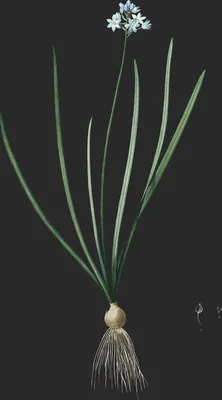
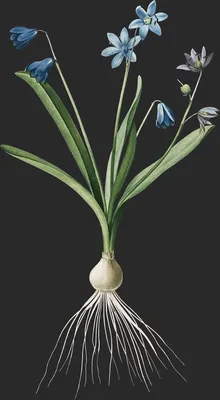
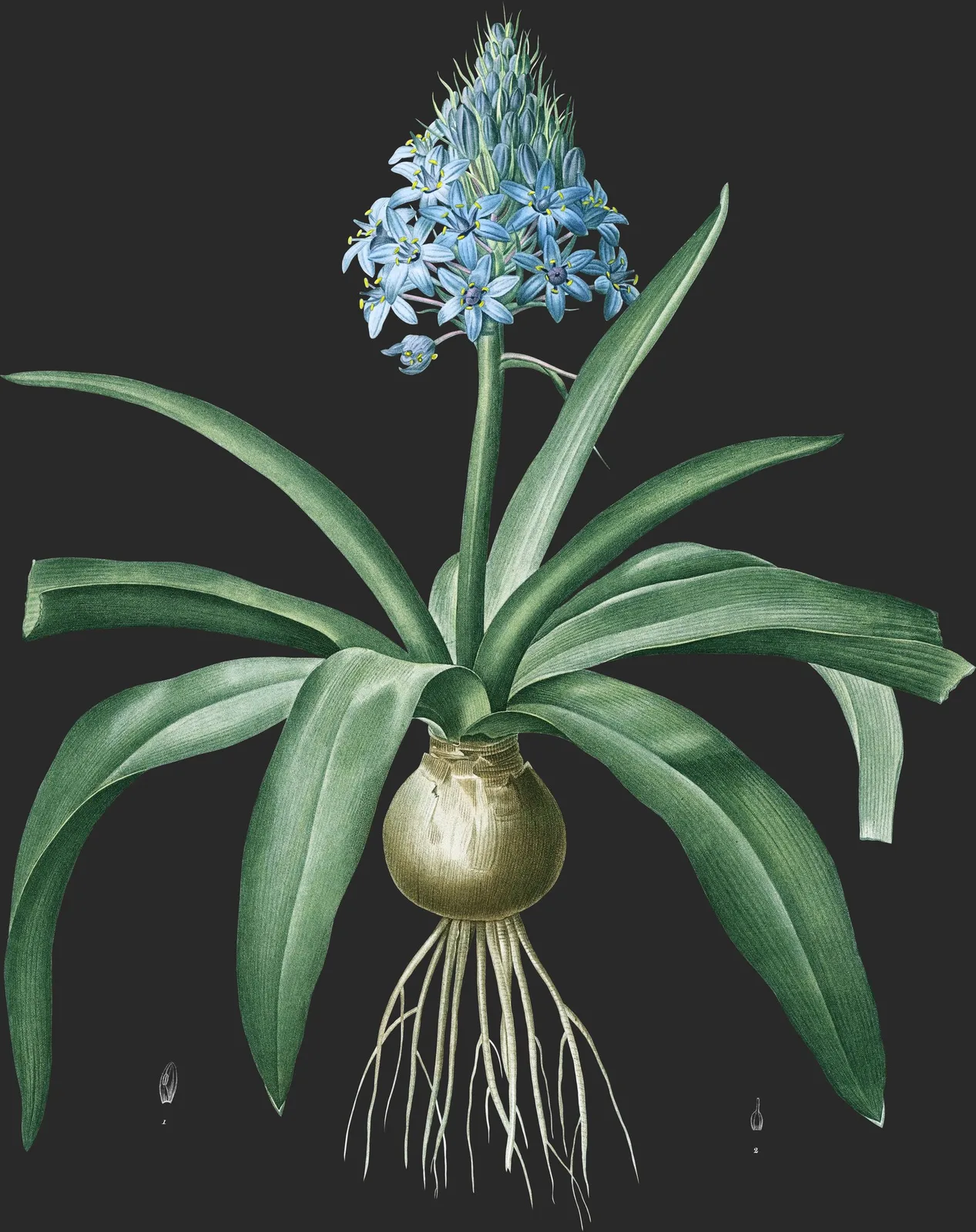
Une grosse bulbe ovoïde, solide, couverte de plusieurs tuniques blanchâtres, donne naissance à des feuilles étalées en large rosette sur la ferre, linéaires, légèrement ondulées, un peu ciliées sur les bords, courbées en canal vers leur base, longues de 1 à 3 décimètres sur 10 à 15 millimètres de largeur.
La hampe est eylindrique, droite, plus courte que les feuilles, terminée par une grappe conique, serrée, composée d’un grand nombre de fleurs: celles-ci sont ordinairement d’un bleu violet, quelquefois bleuâtres ou blanches. Leurs pédicelles sont cylindriques, beaucoup plus longs dans le bas que dans le haut de la grappe, accompagnés de bractées membraneuses, longues, pointues, lanecéolées, quelquefois changées en de véritables feuilles alongées et pendantes.
Les six lobes du périgone sont étalés, elliptiques, un peu pointus, persis-tants. Les six étamines sont de la même couleur que le périgone, un peu plus courtes que lui, composées de filaments en forme d’alêne, élargis à leur base, et d’anthères d’un bleu violet, à deux loges pleines d’un pollen jaune. L’ovaire est arrondi, blanchâtre, surmonté d’un style court, filiforme, droit, terminé par un stigmate simple. Le fruit est, comme dans toutes les Scilles, une capsule à trois angles, à trois loges, à trois valves munies d’une cloison sur leur face interne, à plusieurs graines dans chaque loge.
Histoire
Quoique la plante dont nous donnons ici la description porte depuis longtemps le nom de Scille de Pérou, il n’est rien moins que súr qu’elle soit indi-gènedu Nouveau-Monde: ce qui est certain, c’est qu’elle est maintenant sauvage en Barbarie, dans les champs et sur les côtes du Portugal. Une ancienne tradition atteste qu’elle est autrefois venue de l’Amérique méridionale. ♃.
Cette belle Liliacée est assez répandue dans les jardins de botanique, et se cultive même comme fleur d’ornement dans les jardins des amateurs. En Barbarie, elle fleurit en hiver; dans notre climat elle fleurit au milieu du prin-temps. Sa grappe reste longtemps en fleur.
Explication de la planche
- Etamine.
- Le pistil.
Fam. des Asphodèles. Juss.—Hexandrie monogynie. Lin.
- Scilla peruviana. S. corymbo conferto conico. Lin. Spec. 442. Mill. Dict. n. 4. Willd. Spec. 2. p. 127. Desf. atl. 1. p. 298, Link. ann. bot. 1. p. 99.
- Scilla peruviana. S. foliis lato-linearibus scapo longioribus in orbem recumbentibus, bracteis solitariis pedicellos subæquantibus, floribus numerosissimis in corymbum magnum subconicum congestis, coronâ stellato patente persistente, filamentis lato-subulatis. Gawl. in Curt. bot. mag. t. 749.
- Scilla peruviana, corymbo conferto conico, foliis in orbem expansis margine ciliatis. Pers. ench. 1. p. 366.
- Scilla criophora. Mill. Dict. n. 10.
- Ornithogalum cœruleum lusitanicum latifolium. Tourn. inst. 381. et
- Ornithogalum criophorum peruvianum. Tourn. inst. 381.
- Hyacinthus stellatus peruvianus. Clus. hist. 1. p. 182. f. 2. et
- Eriophorus peruvianus. Clus. hist. 1. p. 173. f. 1. Best. Eynst. vern. 2. t. 9. f. 1.
- Hyacinthus stellatus peruvianus multillorus, flore cœruleo. Moris. hist. sect. 4. t. 12. f. 19.
- Hyacinthus peruvianus. J. Bauh. hist. 2. p. 585. ic.
- Hyacinthus indicus bulbosus stellatus. C. Bauh. pin. 47. Rudb. elys. f. 1. p. 37. 1.
- Great spanith starry Jacinth. Park. par. 25. f. 7.
Twelve ways of seeing
- measured cast blue
- slightly upright 1.26 : 1
- published 1805
- Plate 167
Not a catalogue entry but a way of looking: how to stand, what to notice, how the line was cut, when it flowers, where it came from, who made it — and then the poems and the classics that taught China to see the same flower. Read the twelve in order and the plate opens.
-
First Look
江馆清秋,晨起看竹,烟光日影露气,皆浮动于疏枝密叶之间。
—— 清·郑板桥《题画竹》
On an autumn morning at the river lodge I looked at the bamboo: mist, sunlight, dew, all drifting among the sparse and dense leaves.
Slightly taller than wide; the eye lands above centre. Then step in close: watch where colour meets line, and whether the line ever breaks. Third, find where the green is deepest: the whole tonal order is measured from that patch.
-
Name and Thing
The binomial is Scilla peruviana: the first word is the genus it belongs among, the second the epithet that sets it apart. Two words carry a whole provenance. The older system filed it under Asparagaceæ by overall affinity; Linnaeus, counting stamens only, placed it in Hexandria — two ways of asking what a plant is. The Chinese name 地中海蓝钟花 is a modern rendering of the Latin, not an old garden name.
-
Form and Colour
Measured on this plate: flower colour covers 3.1% of the sheet, foliage 12.4%, the cast blue with a second note of yellow-green. No other plate shares exactly this measure. Bulbous plants store the year underground — bulb, corm or tuber — then send up a few thick leaves and a single scape, with six tepals in cup, funnel or star. Filed under green — a moss green, a colour that comes mostly from leaf and stem. Three things fix the habit: leaf arrangement, tepal count, and how the flower is borne.
-
Composition
Slightly taller than wide, the plant set a little above centre. (about 1.26 : 1) No details are appended: a plate for looking, not for keying out. The plant covers only 26% of the sheet, centred near the centre; the emptiness is where the eye rests. Old plates set the plant slightly off centre, with unequal margins — that small imbalance is what keeps it alive.
-
Line and Colour
The first half of the nineteenth century moved from copper to steel to lithography; stipple could render the softest transition. Craft leaves franker evidence than inscriptions.
-
Season
Early spring to early summer, genus by genus: tulips and hyacinths first, gladiolus and amaryllis later. The year 1805 on the plate is that of publication, not of flowering — the gathering came a year or two earlier. The plate records ten days of peak; the other three hundred are leaf, fruit and rest.
-
Provenance
Three homelands: the Mediterranean, Central Asia and South Africa. The tulip came from Ottoman gardens and became a Dutch mania; South African bulbs filled European glasshouses after 1800. In the same volume the kin are shelved together; set several plates side by side.
-
The Book and the Hand
“The Liliaceae” was drawn by Pierre-Joseph Redouté and published 1802-1816. This plate is Plate 167, book page 167. The image is public domain; the hand-colouring is still one person's hand.
-
Poetic Resonance
兰陵美酒郁金香,玉碗盛来琥珀光。
—— 唐·李白《客中行》
Fine wine of Lanling, fragrant with turmeric; poured in a jade bowl, it glows like amber.
The poem gives the mood first and the picture supplies the form; set the line beside the plate and the green the corolla becomes its resting point.
-
The Written Tradition
气之动物,物之感人,故摇荡性情,形诸舞咏。
—— 南朝梁·钟嵘《诗品序》
The vital breath moves things, things move men, and the stirred heart takes shape in song.
Li Bai's 'orchid wine, fragrant with yujin' is often misread as tulips; the Tang yujin was a turmeric-like root used to scent wine — same name, different plant. You need not parse every word: take the line, and the flower acquires a second face.
-
Symbolism
The tulip was an imperial emblem in Istanbul and a speculative bubble in Amsterdam; the hyacinth sprang from a boy's blood in Greek myth. What bulbs share is concealment: next year kept underground. Flower language was added later; the flower knows nothing of it, and that innocence is part of its power.
-
What to Take Away
Appreciation is not knowledge but habit — one more look each time. Two centuries on, the plant may still flower in some garden; the one on this sheet stopped in the season of 1805.