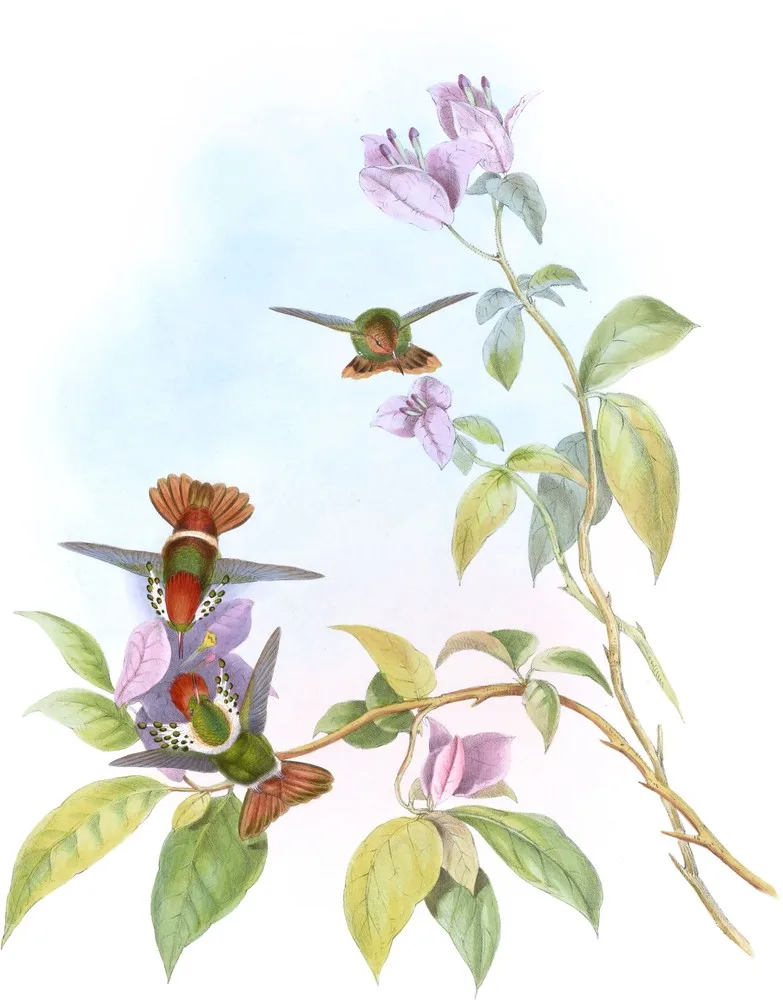
Lophornis Gouldi
Lophornis Gouldi
Gould’s Coquette
- 学名
- Lophornis Gouldi
- 合集
- 古尔德蜂鸟图谱
- 绘者
- John Gould(约翰·古尔德)
- 年代
- 1852
- 图版号
- Pl. 118, Vol. III
- 原书页码
- p.118
- 授权
- CC0 1.0 Universal (Public domain)
十观
- 略纵 1.28∶1
第一眼
竖划三寸,当千仞之高;横墨数尺,体百里之迥。
—— 南朝宋·宗炳《画山水序》
三寸的竖线可当千仞高山,几尺横墨能容百里之远。尺幅从来不是障碍,取舍才是本事。这一幅略高于宽,落点在中央偏上那只鸟的头部。第二步凑近一寸:看线与色的交界,色有没有压住线,线有没有断。第三步,把视线放到最深的那一小块:整幅的用色秩序,都是从那里排开的。
名与实
学名 Lophornis gouldi:前一词是属,管它归在哪一类;后一词是种加词,管它在这一类里凭什么与众不同。名字是通行证,也是懒办法——记住两个词,就抓住了一整个物种。此幅尚无通行中文名,姑以学名相称;在没有本地名字的地方,学名就是它唯一的身份证。
形与色
蜂鸟为美洲最小之鸟,喙细长如针,舌分叉成管,可伸入花心吸蜜;翼小而振频极高,能悬停、能倒飞。此幅未作色相归档,只能就形制论。看形制不必求全:记住喙形、翼式与栖姿,这一类的骨架就立住了。
构图与呼吸
画幅略高于宽,鸟身居中偏上,视线落在头部与喙。全幅只画一只,不作解剖附图——这类图更近于“观赏”,而非“鉴定”。试着用拇指遮住空白处——画面立刻变闷;放开,它才重新“喘上气”。留白,是给主体让出的气口。
一刀一色
十九世纪后半叶,石版与彩色石印渐成主流:颜色可以直接印出,不再依赖手工,线条反倒退居其次。图像的“准确”提高了,手性却淡了。还有一种证据在纸背:铜版压进纸里的那道痕、上色处微微凸起的颜料、再版时磨浅的线。扫描件里也能看出七分。想动笔临它的人记住一句:先铺大块的形与色,干后再收细部;石印的柔和层次来自薄涂与网点,水彩分两三遍淡铺即可逼近。
诗境
穿花蛱蝶深深见,点水蜻蜓款款飞。
—— 唐·杜甫《曲江二首》
中土无蜂鸟,然“穿花”之态,杜甫早已写过:贴着花心走,是采蜜者的共同姿态。诗以气行,画以形立;两种“看”叠在一起,才是看画的意思。
花语
阿兹特克以蜂鸟为战神与太阳的化身;欧洲维多利亚时代则以蜂鸟为收藏与装饰的极致,百万只羽毛被做成胸饰。中国旧籍无此鸟,故无象征——这空白本身,就是一部博物学交流史。象征多半来自形状与气味:像杯的、像泪的、香的、臭的——先有形状,后有意义。
时与地
温带种类的蜂鸟则随花北迁,一年往返数千公里。仅产美洲,自阿拉斯加南部至火地岛,以安第斯山最为繁盛。中土无蜂鸟,汉籍不载,晚清海外游记始见其名。图上所记的 1852 年是刊行之年,不是采到那只鸟的年份;真正的观察记录通常比出版早一两年。那一代人对这类鸟的知识,多半来自标本与笼养。看这一类图,不妨把产地和季节都当“据说”来读。
书与人
《古尔德蜂鸟图谱》只署了约翰·古尔德一个人的名字。版画是集体工程:绘图、刻版、上色各有其人,真正决定这幅图好不好看的,常是没留下名字的刻工与上色师。
带走一双眼睛
下次看鸟,别急着认名:先看它停的姿态,再看羽色在哪一段最深,最后才翻图鉴——顺序一换,看鸟就从“对答案”变成了“看画”。二百年后,这只鸟的后代或许仍在某处活着;而纸上这一只,永远停在 1852 年的那个季节。
关于本图版
这幅图版出自《古尔德蜂鸟图谱》(Gould's Hummingbirds),由约翰·古尔德绘制,1849—1887 年间出版。原书题作“Lophornis Gouldi”,归入蜂鸟科(Trochilidae)。
全编共收录 421 幅图版,本图是其中一幅,原书将其列为 Pl. 118, Vol. III,见第 118 页,版式为纵幅。图为公有领域原件的修复扫描,构图与设色未经改动。
原书文字(英文 / 法文)
Northern Brazil
If, in the course of my ornithological labours, I have seldom named new birds after individuals, it is not that I think there are not many living naturalists worthy of such an honour, but because I consider the practice an objectionable one; my opinion being that specific appellations should always express some peculiarity pertaining to the species to which they are applied: entertaining then this view of the subject, I must say, that, although fully sensible of the compliment paid me by M. Lesson, in naming the present bird after myself, I should have been better pleased if some more appropriate appellation had been given to such a beautiful species; a species, moreover, which is so rare in the collections of Europe, that few of them contain examples.
The first specimen known,—that from which M. Lesson took his description,—forms part of Mr. Leadbeater’s collection; another single example, gracing that of Mr. Loddiges, was brought to this country by the celebrated traveller Burchell. Those in my own collection were obtained by the indefatigable collector, Mr. Hauxwell, who shot four or five males and two females near the city of Para; these, with two or three more from the Upper Amazon, deposited in other collections, are nearly if not all that are known. It is evidently a continental species,—that is, it is never found, like its near ally the L. ornatus, in Trinidad or any other of the West Indian Islands. North Brazil and the banks of the Amazon, from the embouchure of that mighty river to its upper ramifications in Peru, are, I believe, its true habitat; and its rarity with us is doubtless due to the infrequency with which those remote districts are visited by travellers and collectors, for there seems to be no reason for supposing that in its own particular province it is less numerous than its congeners. In size and structure it very closely assimilates to L. ornatus, but the neckplumes, which in that species are light chestnut-red, are always pure white, and have the terminal spangles broader and rounder; it is also more delicate in form, a feature observable in both sexes. Of its habits and manners nothing is known.
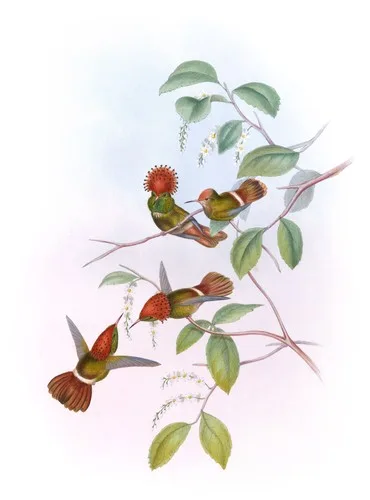
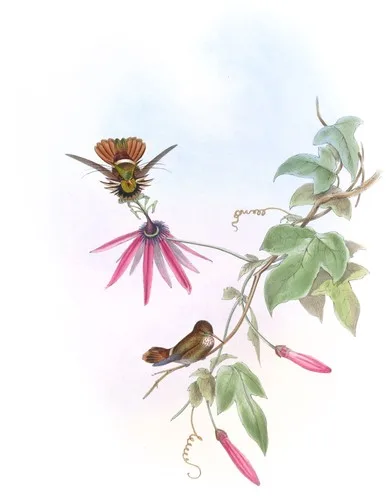
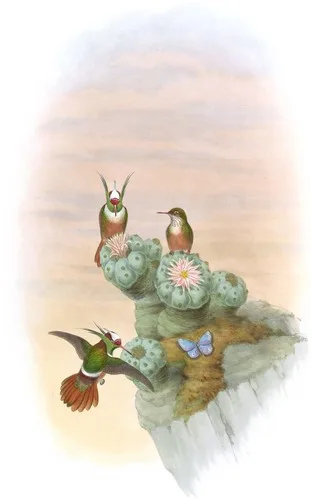
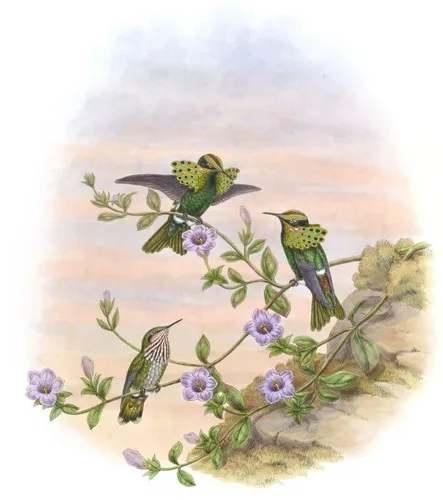
The male has the head and crest rich chestnut-red; upper surface and wing-coverts bronzy green; wings dark purplish brown; across the lower part of the back a band of white; rump chestnut-brown; upper tail-coverts bronzy green; tail dark chestnut-red, the two central feathers bronzy green on their apical half, and the lateral ones broadly edged with brownish black; forehead and throat luminous green; on each side of the neck a series of graduated white plumes, with a large spangle of luminous green at the tip of each; under surface bronzy green; bill fleshy red, becoming dark brown at the tip.
The female has the head and upper surface golden green; a narrow band of white across the lower part of the back; upper tail-coverts tipped with dark bronzy brown; tail bronzy green at the base, crossed by a broad dusky band, and tipped with buff; lores and throat rust-red; under surface bronzy green.
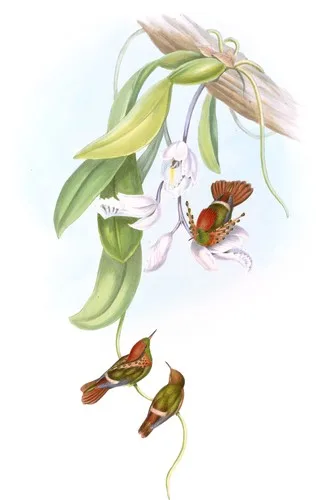
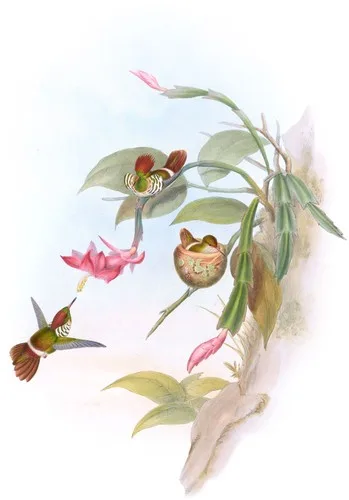
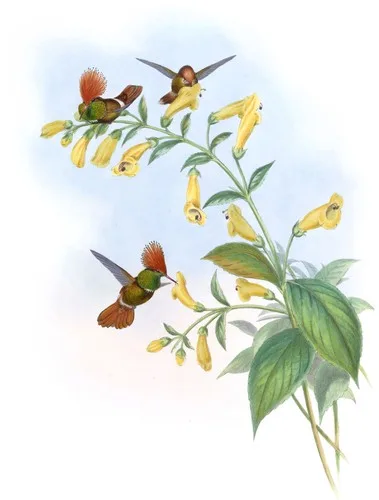
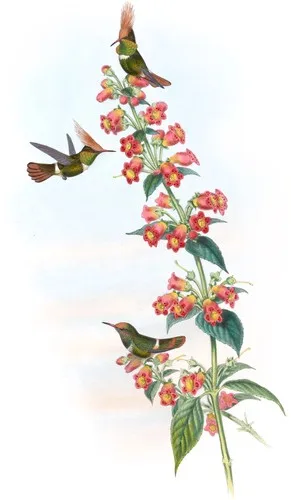
The figures are of the natural size, and represent the males engaged in one of the numerous aïrial combats which so frequently occur among the species of the present genus.
References
- Ornismya Gouldii, Less. Hist. Nat. des Troch., p. 103. pl. 36.
- Trochilus Gouldii, Jard. Nat. Lib. Humming Birds, vol. ii. p. 75. pl. 12.
- Lophornis Gouldii, Less., Jard. Gen. et Syn. des Ois. du Genre Trochilus, p. xli.
- Mellisuga Gouldi, Gray and Mitch. Gen. of Birds, vol. i. p. 118, Mellisuga, sp. 87.
- Lophornis gouldi, Bonap. Consp. Gen. Av., p. 83, Lophormis, sp. 5.—Ib. Rev. et Mag. de Zool 1854, p. 257.
- Bellatrix Gouldii, Reichenb. Aufz. der Colibris, p. 12.