缨冠蜂鸟
Lophornis ornatus
Lophornis ornatus
Tufted Coquette
- 中文名
- 缨冠蜂鸟
- 学名
- Lophornis ornatus
- 合集
- 古尔德蜂鸟图谱
- 绘者
- John Gould(约翰·古尔德)
- 年代
- 1852
- 图版号
- Pl. 117, Vol. III
- 原书页码
- p.117
- 授权
- CC0 1.0 Universal (Public domain)
十观
- 纵幅 1.55∶1
第一眼
真山水之川谷,远望之以取其势,近看之以取其质。
—— 宋·郭熙《林泉高致·山水训》
远看取其气势,近看取其质地。八个字,就是看画的两步:先退后看整体,再凑近看笔与色。看花鸟图版一样管用。这一幅是竖的:眼睛从下往上走,落点在中段那只鸟身上。先别急着看羽毛,让姿态先立起来。第二步凑近一寸:看线与色的交界,色有没有压住线,线有没有断。第三步,把视线放到最深的那一小块:整幅的用色秩序,都是从那里排开的。
名与实
学名 Lophornis ornatus:前一词是属,管它归在哪一类;后一词是种加词,管它在这一类里凭什么与众不同。双名制的好处是唯一:全世界叫这个名字的,只能是这一种。中文名“缨冠蜂鸟”是后人据学名回译的通行叫法,与古书里的旧名未必对得上——名与物之间,总隔着一层翻译。
形与色
翼小而振频极高,能悬停、能倒飞;羽色非颜料所致,是羽枝结构折射的光,随角度而变。此幅未作色相归档,只能就形制论。颜色不是平涂的:最浅处近乎纸色,最深处在花瓣重叠的缝里。把这两处找到,画面的呼吸就出来了。
构图与呼吸
画幅高而窄,鸟栖在枝的中段,上下留白多——十九世纪鸟谱的标准版式,留给它飞走的余地。全幅只画一只,不作解剖附图——这类图更近于“观赏”,而非“鉴定”。试着用拇指遮住空白处——画面立刻变闷;放开,它才重新“喘上气”。留白,是给主体让出的气口。
一刀一色
十九世纪后半叶,石版与彩色石印渐成主流:颜色可以直接印出,不再依赖手工,线条反倒退居其次。图像的“准确”提高了,手性却淡了。还有一种证据在纸背:铜版压进纸里的那道痕、上色处微微凸起的颜料、再版时磨浅的线。扫描件里也能看出七分。想动笔临它的人记住一句:先铺大块的形与色,干后再收细部;石印的柔和层次来自薄涂与网点,水彩分两三遍淡铺即可逼近。
诗境
夫列子御风而行,泠然善也,旬有五日而后反。
—— 《庄子·逍遥游》
蜂鸟悬停于空,不落不飞,最近于“御风”。庄子说的是一种自由的姿态,蜂鸟把它做成了生理事实。古人写到这一层,已不只是赏花,是借花说人;画面则只负责把那朵花留住。
花语
阿兹特克以蜂鸟为战神与太阳的化身;欧洲维多利亚时代则以蜂鸟为收藏与装饰的极致,百万只羽毛被做成胸饰。中国旧籍无此鸟,故无象征——这空白本身,就是一部博物学交流史。象征多半来自形状与气味:像杯的、像泪的、香的、臭的——先有形状,后有意义。
时与地
热带美洲几乎全年可见,花期即其季节。仅产美洲,自阿拉斯加南部至火地岛,以安第斯山最为繁盛。中土无蜂鸟,汉籍不载,晚清海外游记始见其名。图上所记的 1852 年是刊行之年,不是采到那只鸟的年份;真正的观察记录通常比出版早一两年。图上的产地常是“据说来自”,图上的花期常是“盛开那十日”——两处都要打个折扣读。
书与人
《古尔德蜂鸟图谱》只署了约翰·古尔德一个人的名字。版画是集体工程:绘图、刻版、上色各有其人,真正决定这幅图好不好看的,常是没留下名字的刻工与上色师。
带走一双眼睛
把这三件事带走:先整体后细节;先线后色;先看画再翻书。任何一张老图版,都可以用这三条读。1852 年的那只鸟早已化作尘土,它留在纸上的样子,却比任何一只活着的同类都长寿。
关于本图版
《古尔德蜂鸟图谱》(Gould's Hummingbirds)由约翰·古尔德绘制,1849—1887 年间印行,本图即其中一幅。画面主体是缨冠蜂鸟(Lophornis ornatus),在分类体系中列于蜂鸟科(Trochilidae)。
该合集全编共 421 幅图版,此图为其中之一,图版编号 Pl. 117, Vol. III,对应原书第 117 页,版式为纵幅。扫描件取自公有领域原件,经高分辨率修复与色彩校正,可按原大放大查看线条与设色。
原书文字(英文 / 法文)
Northern Brazil, Guiana, and Trinidad
The Lophornis ornatus does not appear to have been known to Linneus, for I find no mention of it in the 12th or last Edition of his “Systema Naturæ;” a good description of it, however, will be found in the 13th or Gmelin’s Edition; this then appears to be the only member known at that time of a genus now comprising many species, which, for grace and beauty, are second to none in the great family of the Trochilide, and all of which are decorated with elegant, lengthened and spangled neck-plumes, or magnificent crests; the former being most conspicuous in some of the species, while in others, such as L. Regulus and L. Reginæ, the beautiful crest is the more remarkable feature.
The L. ornatus, which is strictly an inhabitant of the lowland districts of tropical America, enjoys a somewhat extensive range over the eastern part of that continent, being found from the Caraccas on the north to Brazil on the south, and particularly numerous in all the intermediate countries, of Demerara, Surinam, and Cayenne; it is also equally abundant on the island of Trinidad. Prince Maximilian of Wied states, that in Brazil he found it on dry and arid plains clothed with a scanty and bushy vegetation; and such would seem to be the habit of the bird in Trinidad, since it there flies around the low flowering shrubs of the open parts of the country, rather than in the more wooded or forest districts.
The nest is a small round cup-shaped structure, composed of some cottony material bound together with cobwebs, and decorated externally with small pieces of lichens and mosses.
So great a similarity reigns among the females of many species of the genus Lophornis, that it is very difficult to distinguish the one from the other, especially as the highly ornamental neck-plumes of the male are entirely absent in the other sex.
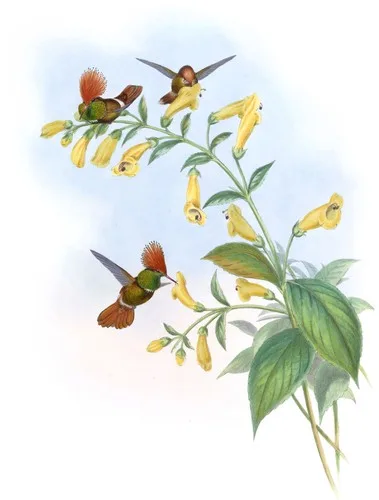
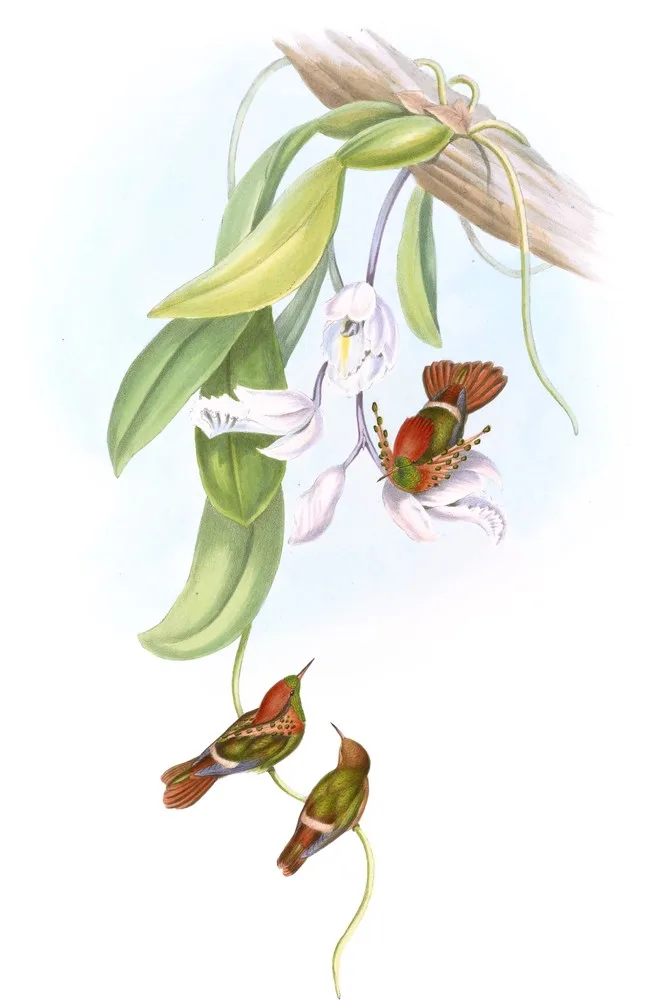
The male has the head and crest rich chestnut-red; upper surface and wing-coverts bronzy green; wings dark purplish brown; across the lower part of the back a band of white; rump chestnut-brown; upper tailcoverts bronzy green; tail dark chestnut-red, the two central feathers bronzy green on their apical half, and the lateral ones edged with brownish black; forehead and throat luminous green; on each side of the neck a series of graduated plumes of a light chestnut-red, with a spangle of luminous green at the tip of each; under surface bronzy green; bill fleshy red, dark brown at the tip.
The female has the head and upper surface bronzy green; a narrow band of white across the lower part of the back; upper tail-coverts tipped with bronzy red; tail bronzy green, crossed near the extremity by a broad dusky band and tipped with buff; lores and sides of the throat rufous; centre of the throat buffy white, with a small spot of black at the tip of each feather; an obscure band of white across the breast; under surface bronzy green.
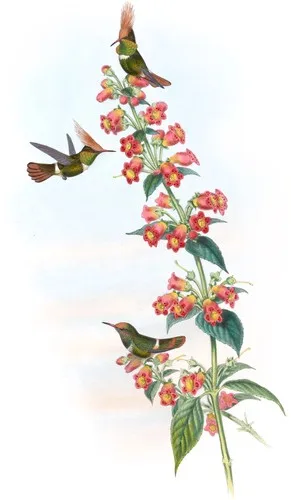
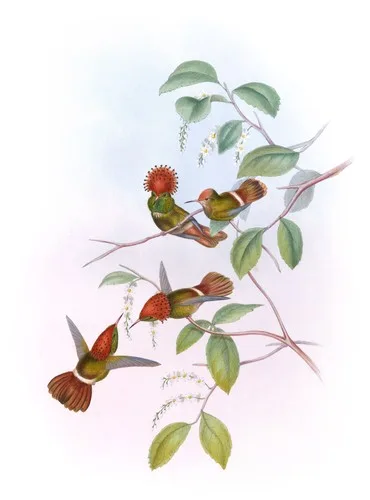
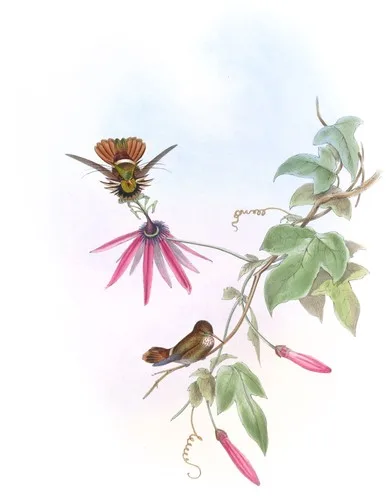
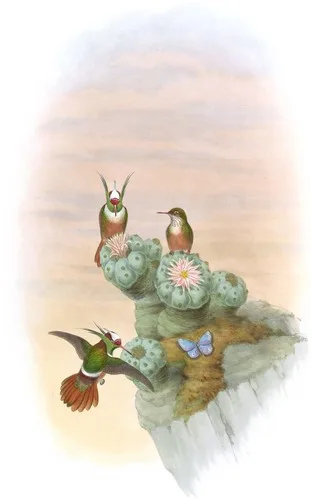
The Plate represents two males and a female of the natural size. The pretty Orchid is copied from a drawing of a Brazilian species kindly sent to me by Mr. Reeves of Rio de Janeiro.
References
- Trochilus ornatus, Lath. Ind. Orn., vol. i. p. 318.—Shaw, Mus. Leverianum, p. 1380. pl. 7.— Gmel. Edit. of Linn. Syst. Nat., tom. i. p. 497.—Shaw, Gen. Zool., vol. vii. p. 345.
- Le Hupe-Col, Buff. Hist. Nat. des Ois., tom. vi. p. 18.—Ib. Sonn. Edit., tom. vii. p. 165.
- L’Oiseau mouche, dit Hupecol de Cayenne, Buff. Pl. Enl. 640. fig. 3.
- Le Hupecol, Vieill. Ois. dor., tom. i. p. 94. pls. 49, 50, 51.—Ib. Nouv. Dict. d’Hist. Nat., tom. vii. p. 364.—Ib. Ency. Méth. Orn., part 1. p. 565.—Drapiez, Dict. Class. d’Hist. Nat., tom. iv. p. 324.
- Tufted-necked Humming Bird, Lath. Gen. Syn., vol. ii. p. 784.—Ib. Gen. Hist., vol. iv. p. 348. pl. Ixxviii—Jard. Nat. Lib. Humming Birds, vol. i. pp. 112 & 114. pls. 15 & 16.
- Ornismya ornata, Less. Hist. Nat. des Ois. mou., pp. xl et 139. pl. 41.—Ib. Hist. Nat. des Troch., p. 77. pl. 24.
- Mellisuga ornata, Gray and Mitch. Gen. of Birds, vol. i. p. 118, Mellisuga, sp. 84.
- Lophornis auratus, Bonap. Consp. Gen. Av., p. 88, Lophornis, sp. 1.
- Lophornis ornatus, Ib. Rev. et Mag. de Zool. 1854, p. 257.
- Lophornis ornata, Less. Ind. Gen. et Syn. des Ois. du Gen. Troch., p. xli.—Ib. Traité d’Orn., p. 285.—Gray, List of Gen. of Birds, 2nd edit., p. 19.—Reichenb. Aufz. der Colibris, p. 12.