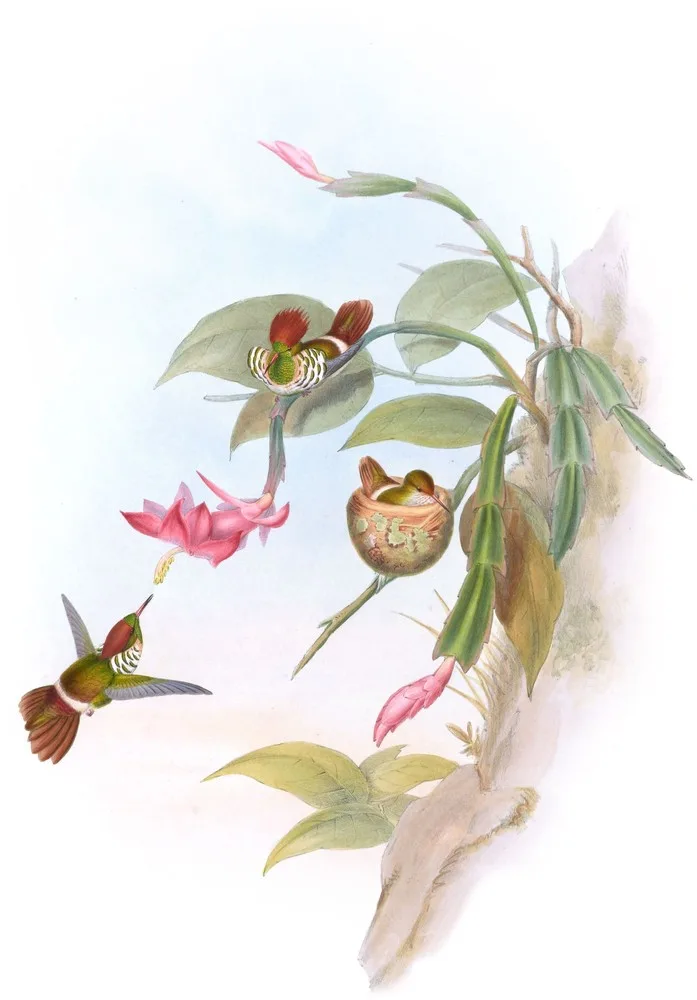
Lophornis magnificus
Lophornis magnificus
Frilled Coquette
- 学名
- Lophornis magnificus
- 合集
- 古尔德蜂鸟图谱
- 绘者
- John Gould(约翰·古尔德)
- 年代
- 1852
- 图版号
- Pl. 119, Vol. III
- 原书页码
- p.119
- 授权
- CC0 1.0 Universal (Public domain)
十观
- 纵幅 1.43∶1
第一眼
六法者何?一、气韵生动是也;二、骨法用笔是也;三、应物象形是也;四、随类赋彩是也;五、经营位置是也;六、传移模写是也。
—— 南齐·谢赫《古画品录》
一千五百年前的六条标准:气韵、用笔、形似、设色、构图、临摹。你在这幅图上一样样对过去,就是一次完整的读画。这一幅是竖的:眼睛从下往上走,落点在中段那只鸟身上。先别急着看羽毛,让姿态先立起来。第二步凑近一寸:看线与色的交界,色有没有压住线,线有没有断。第三步,把视线放到最深的那一小块:整幅的用色秩序,都是从那里排开的。
名与实
学名 Lophornis magnificus:前一词是属,管它归在哪一类;后一词是种加词,管它在这一类里凭什么与众不同。一百多年前的命名者,把一种植物的来历压进了两个词。此幅尚无通行中文名,姑以学名相称;在没有本地名字的地方,学名就是它唯一的身份证。
形与色
蜂鸟为美洲最小之鸟,喙细长如针,舌分叉成管,可伸入花心吸蜜;翼小而振频极高,能悬停、能倒飞。此幅未作色相归档,只能就形制论。画幅高而窄,形与色的关系因此看得格外清楚:先读轮廓,再读色层,最后才看笔触。
构图与呼吸
画幅高而窄,鸟栖在枝的中段,上下留白多——十九世纪鸟谱的标准版式,留给它飞走的余地。全幅只画一只,不作解剖附图——这类图更近于“观赏”,而非“鉴定”。试着用拇指遮住空白处——画面立刻变闷;放开,它才重新“喘上气”。留白,是给主体让出的气口。
一刀一色
十九世纪后半叶,石版与彩色石印渐成主流:颜色可以直接印出,不再依赖手工,线条反倒退居其次。图像的“准确”提高了,手性却淡了。拿放大镜(或手机微距)看三处:喙缘、覆羽、题名。线若连续不断,是刻的;色若越过轮廓半毫米,是手涂的。想动笔临它的人记住一句:先铺大块的形与色,干后再收细部;石印的柔和层次来自薄涂与网点,水彩分两三遍淡铺即可逼近。
诗境
穿花蛱蝶深深见,点水蜻蜓款款飞。
—— 唐·杜甫《曲江二首》
中土无蜂鸟,然“穿花”之态,杜甫早已写过:贴着花心走,是采蜜者的共同姿态。诗以气行,画以形立;两种“看”叠在一起,才是看画的意思。
花语
阿兹特克以蜂鸟为战神与太阳的化身;欧洲维多利亚时代则以蜂鸟为收藏与装饰的极致,百万只羽毛被做成胸饰。中国旧籍无此鸟,故无象征——这空白本身,就是一部博物学交流史。象征多半来自形状与气味:像杯的、像泪的、香的、臭的——先有形状,后有意义。
时与地
温带种类的蜂鸟则随花北迁,一年往返数千公里。仅产美洲,自阿拉斯加南部至火地岛,以安第斯山最为繁盛。中土无蜂鸟,汉籍不载,晚清海外游记始见其名。图上所记的 1852 年是刊行之年,不是采到那只鸟的年份;真正的观察记录通常比出版早一两年。图上的产地常是“据说来自”,图上的花期常是“盛开那十日”——两处都要打个折扣读。
书与人
《古尔德蜂鸟图谱》只署了约翰·古尔德一个人的名字。图版今属公有领域,可以自由取用;但纸上那层手工上色,仍是两百年前某一个人的手。
带走一双眼睛
鉴赏力不是知识,是习惯:每次多看一眼,十年之后你看什么都和别人不一样。二百年后,这只鸟的后代或许仍在某处活着;而纸上这一只,永远停在 1852 年的那个季节。
关于本图版
此图原刊于《古尔德蜂鸟图谱》(Gould's Hummingbirds),绘者为约翰·古尔德,成书于 1849—1887 年间。图中描绘的是 Lophornis magnificus,归入蜂鸟科(Trochilidae)。
全编共收录 421 幅图版,本图是其中一幅,原书将其列为 Pl. 119, Vol. III,见第 119 页,版式为纵幅。图像由公有领域原件扫描修复而来,细节在放大视图中仍清晰可辨。
原书文字(英文 / 法文)
South-eastern Brazil
The discovery of this beautiful little species of Lophornis is said to have been made by M. De Lalande, the celebrated French traveller, at the period of whose visit to Brazil and for some time afterwards the bird was very rarely to be met with in our collections; such, however, is no longer the case, for its proper habitat having been ascertained, it is killed and skinned by the negroes, and the skins, bearing a certain market value, are sent to this country and to France in great numbers.
Its native country is Brazil; and the localities in which it appears to be most abundant are the provinces of Rio de Janeiro and Minas Geraes. M. De Lalande procured examples in the forests bordering the river Paraiba, to the north of Rio de Janeiro; and MM. Quoy and Gaimard obtained others among the moderately dense vegetation bordering the torrents at the foot of the Organ Mountains. The notes transmitted to me by Mr. Reeves of Rio de Janeiro merely mention that it inhabits that province and Minas Geraes, but unfortunately give no account of its habits.
The nest is a small round cup-shaped structure, composed of a rufous-coloured fungus-like substance, coated externally with cobwebs and fine vegetable fibres, and decorated with small pieces of lichens.
Like the other members of the genus, this species has the sides of the neck adorned with beautiful snowywhite plumelets; but these plumelets differ in form, being shorter and broader, and are moreover crossed by a band of luminous green at the extremity, instead of having a spot of that colour at the tip.
The same difference which exists between the sexes of the other species also occurs with the present, the female being destitute of the conspicuous decorations of the male.
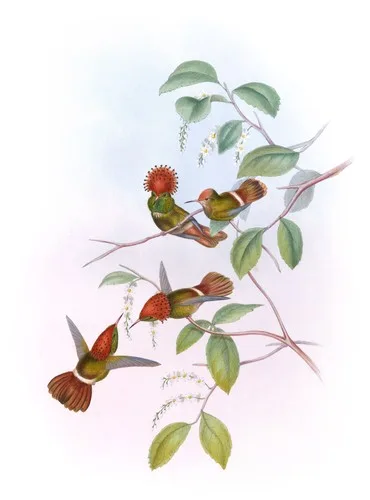
The male has a broad band across the forehead, face and throat luminous green; head and crest dark chestnut-red; upper surface and wing-coverts bronzy green; wings purplish brown; a band of white across the lower part of the back; upper tail-coverts bronzy brown; central tail-feathers bronzy green; lateral ones deep chestnut-red, bordered with brownish black; on each side the neck a series of broad white feathers advancing forward and meeting immediately beneath the green gorget; each of those on the sides of the neck crossed at the tip with a band of luminous green; under surface bronzy green; bill flesh-red at the base, deepening into black at the point.
The female has the head and upper surface bronzy green; a narrow band of white across the lower part of the back; upper tail-coverts tipped with bronzy red; tail deep fawn-colour, crossed towards the extremity by a broad dusky band; throat rufous; under surface bronzy green.
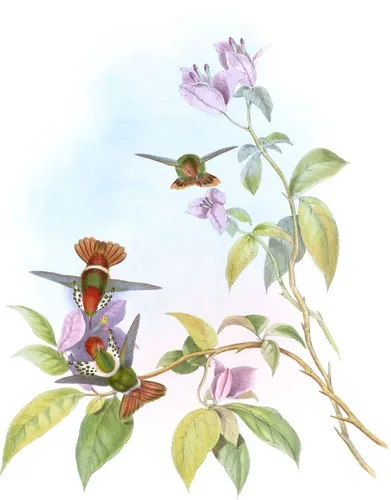
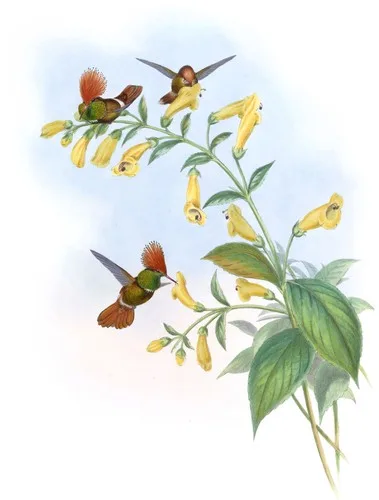
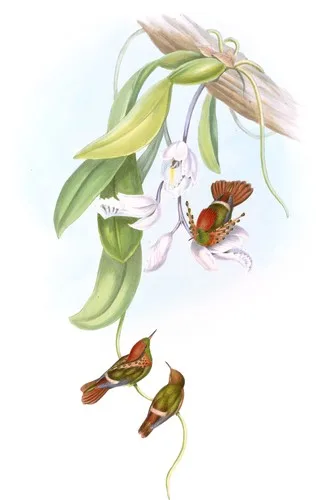
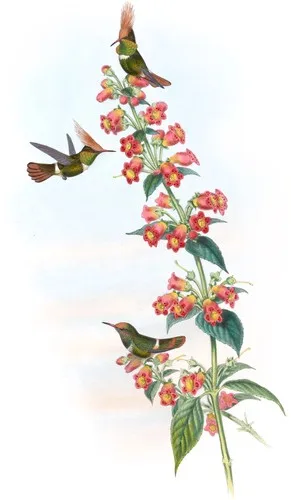
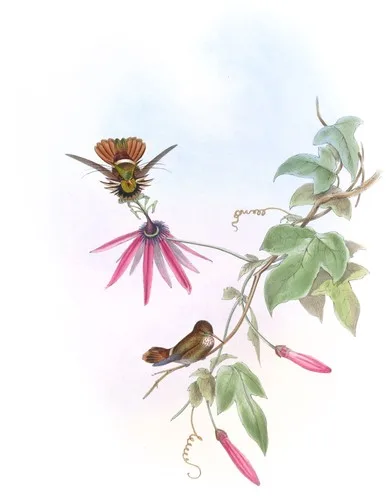
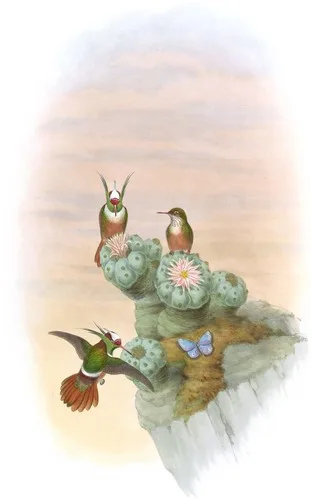
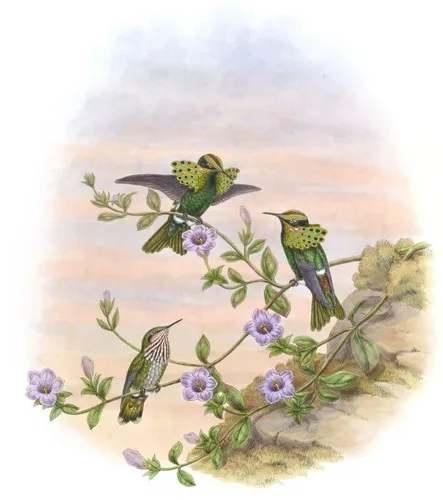
The Plate represents two males and a female with the nest, all of the natural size.
References
- Trochilus magnificus, Vieill. 2nde Edit. du Nouv. Dict. d’Hist. Nat., tom. vii. p. 367, et tom. xxill. p. 428. pl. G 36. fig. 3—Ib. Ency. Méth. Orn., part nu. p. 559.—Ib. Ois. dor., tom. i. pl. 8.—Temm. Pl. Col. 229. fig. 2.—Jard. Nat. Lib. Humming Birds, vol. i. pp. 119 & 121. pls. 19 & 20.—Pr. Max. Beitr. zur Nat. von Bras., p. 79.
- Trochilus decorus, Licht. Verz. der Doubl., p. 14.
- Colibri helios, Spix, Av. Sp. Nov. Bras., tom. i. p. 81. tab. lxxxii. fig. 2.
- Ornismya magnifica, Less. Man. d’Orn., tom. 1. p. 80.
- Ornismya strumaria, Less. Hist. Nat. des Ois. mou., pp. xl & 143. pls. 42 & 43.
- Lophornis strumaria, Less. Ind. Gen. et Syn. des Ois. du Genre Trochilus, p. xlii—lb. Traité d’Orn., p. 285.
- Mellisuga magnifica, Gray and Mitch. Gen. of Birds, vol. i. p. 118, Mellisuga, sp. 88.
- Lophornis magnificus, Bonap. Consp. Gen. Av., p. 83, Lophornis, sp. 2.—Ib. Rev. et Mag. de Zool. 1854, p. 257.
- Bellatrix magnifica, Reichenb. Aufz. der Colibris, p. 12.